Does Freeze-Drying Kill Probiotics? What It Means for Natto Powder
Does freeze-drying kill probiotics? Learn how freeze-drying works, why spore-forming Bacillus can be more resilient than many non-spore-forming bacteria, and why processing, storage and product-specific evidence matter when choosing natto powder.
Does Freeze-Drying Kill Probiotics? What It Means for Natto Powder
Freeze-dried foods are often associated with long shelf life and convenient storage. But when it comes to fermented foods such as natto, an important question comes up: does freeze-drying kill probiotics?
The answer is not a simple yes or no. Freeze-drying is designed to remove water while helping preserve a material's characteristics, but the survival of microorganisms depends on the species, the strain, the processing conditions and how the finished product is stored.
Natto is particularly interesting because it is fermented using Bacillus subtilis var. natto, a bacterium capable of forming protective spores. These spores have different survival characteristics from the active, non-spore-forming bacterial cells commonly found in many probiotic products.
In this guide, we explain how freeze-drying works, why spore formation matters and what to look for when evaluating a natto powder.
1. What is freeze-drying?
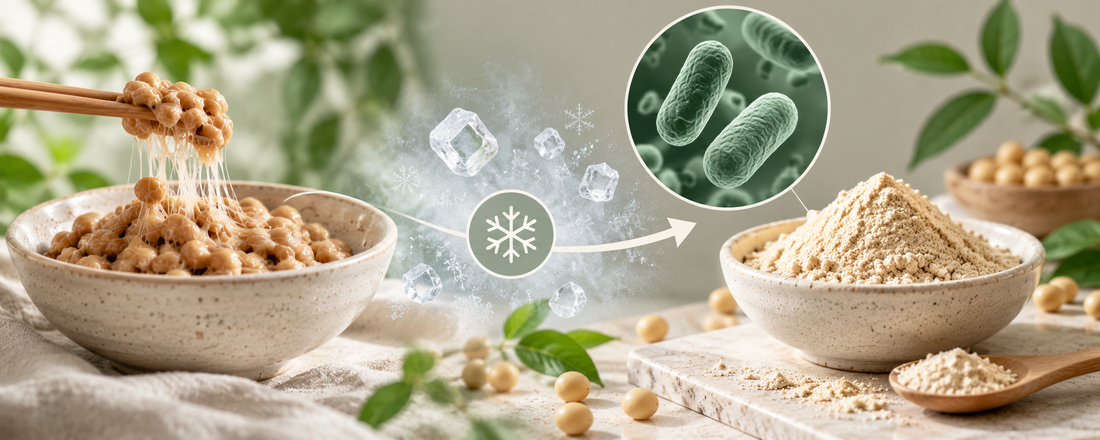
Freeze-drying, also known as lyophilisation, is a dehydration process used to remove water from a material.
In simplified terms, the process generally involves three stages:
-
Freezing: The material is frozen.
-
Primary drying: Under reduced pressure, ice is removed mainly through sublimation, meaning it changes directly from solid ice into water vapour.
-
Secondary drying: Additional moisture is removed to help achieve the desired residual moisture level.
Reducing moisture can help improve storage stability, but freeze-drying does not guarantee that every microorganism survives or that every biological component remains unchanged.
Some microorganisms are sensitive to freezing, dehydration and rehydration. Others are naturally better equipped to tolerate these stresses. The outcome also depends on factors such as the material being dried, the drying conditions, packaging and moisture exposure after processing.
The key point: freeze-drying is a preservation technique, not proof that a product contains a particular number of living microorganisms or delivers a specific health benefit.
2. Why are natto bacteria different?
Natto is traditionally made by fermenting soybeans with Bacillus subtilis var. natto. This bacterium can form endospores when environmental conditions become unfavourable.
An endospore is a dormant, highly resistant structure that allows certain bacteria to survive stresses that would be more damaging to their actively growing cells.
Compared with many non-spore-forming bacteria, spores can be more resistant to conditions such as drying, heat and other environmental stresses. Their resilience is one reason spore-forming Bacillus species are studied in food science and microbial product development.
However, spore formation does not make bacteria indestructible. Survival depends on the strain, the processing method and the conditions experienced during manufacture and storage.
It is also important to distinguish a bacterial spore from an actively growing bacterial cell. A spore is dormant; under suitable conditions, it may germinate and return to a growing state. That possibility does not, by itself, establish what happens in a person's digestive tract or demonstrate a health outcome.
Does Bacillus subtilis var. natto count as a probiotic?
The term probiotic is generally used for live microorganisms that provide a demonstrated health benefit when administered in adequate amounts.
A product containing a particular bacterium or its spores should not automatically be assumed to meet this definition. The evidence needs to relate to the specific microorganism, the amount delivered and the claimed benefit.
For this reason, it is useful to look at the strain identity, the product's microbiological specifications and the research supporting any probiotic claim rather than relying on the word alone.
3. Does freeze-drying kill probiotics in natto powder?
Freeze-drying can reduce the viability of some microorganisms, but it does not necessarily kill all of them. The result depends on the organism and the processing conditions.
For spore-forming bacteria such as Bacillus subtilis var. natto, the presence of spores can provide an advantage during drying and storage. Nevertheless, it would be inaccurate to conclude that every freeze-dried natto product contains viable spores in the same quantities or that all products perform identically.
Several factors influence the finished product.
The starting material
The microbial composition of the natto before processing matters. The initial population, strain characteristics and proportion of cells that have formed spores can all influence the outcome.
The processing conditions
Freezing, dehydration, exposure to oxygen and the overall manufacturing process can affect microbial survival. Different methods and formulations may produce different results.
Moisture and packaging
After drying, exposure to moisture can affect product stability. Packaging quality, seal integrity and the storage environment can therefore matter.
Time and storage conditions
A product's microbial characteristics may change during storage. Temperature, humidity, packaging and the length of time since manufacture can all influence stability.
Testing and verification
The most useful evidence is product-specific: for example, appropriate microbiological testing, clearly stated specifications and stability data that support the manufacturer's claims.
A general statement about the resilience of spore-forming bacteria cannot substitute for verification of a finished product.
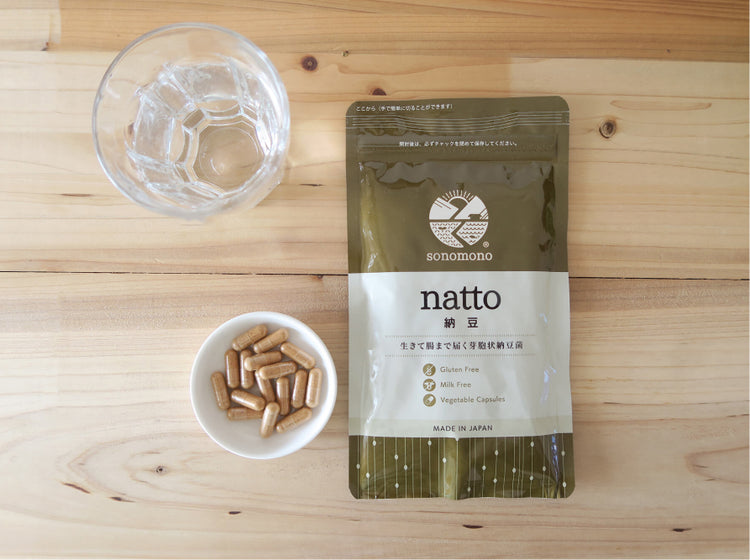
4. What does research on SONOMONO tell us?
Research on the SONOMONO natto preparation provides a relevant example of why the exact formulation matters.
A published study examined capsules containing spores of Bacillus subtilis var. natto SONOMONO and assessed changes in gut microbiota over a 62-day study period.
The researchers reported changes in the relative abundance of certain bacterial groups, including Bifidobacterium and Blautia. These findings are interesting, but they should be interpreted within the study's limitations.
A change in the relative abundance of a bacterial group does not automatically establish an improvement in overall gut health, a clinical benefit or a lasting change in the microbiome. Findings from one study also cannot automatically be applied to every natto powder, every Bacillus strain or every freeze-dried product.
The study investigated a particular preparation. It should not be treated as proof that freeze-drying universally preserves all probiotics or that every natto product will produce the same microbiome response.
Read the published research: SONOMONO study on gut microbiota (Nutrients, 2022).
5. Why use whole freeze-dried natto powder?
Whole natto powder is made from the fermented soybean material rather than being defined solely by a single isolated ingredient.
Depending on how it is produced, whole natto powder may retain a range of components associated with the original fermented food. Its composition can vary according to the fermentation process, the starting soybeans and the manufacturing method.
This is different from a product designed to deliver an isolated enzyme or a standardised amount of a particular compound.
For example:
-
Whole natto powder refers to the powdered fermented food material.
-
Nattokinase supplements are formulated around the enzyme nattokinase, and labels may state its activity in fibrinolytic units (FU).
-
Products standardised for specific microorganisms may specify a strain and a microbial quantity, where measured and declared.
These product types are not interchangeable. One should not assume that a whole-food powder delivers the same enzyme activity, microbial count or clinical effects as a concentrated extract.
At Living Alpha, our product education focuses on helping readers understand what a product is made from, how it is processed and what the available evidence can—and cannot—tell us.
To learn more about the production process, read Inside SONOMONO: How Award-Winning Natto Powder Is Made.
6. How can you assess the quality of freeze-dried natto powder?
When comparing products, look beyond the words freeze-dried, fermented or probiotic on the packaging.
Consider the following questions.
1. Is the ingredient clearly identified?
Check whether the product contains whole natto powder, an extract or an isolated ingredient. These descriptions refer to different preparations.
2. Is the microorganism identified?
If the product makes a microbial or probiotic claim, look for the organism's name and, where applicable, the specific strain. A species name alone may not establish that the product has the same properties as a studied strain.
3. Are microbial quantities stated and supported?
If a product declares a live microorganism count, check what the number represents and whether it is supported by suitable testing. A count at manufacture is not necessarily equivalent to a count guaranteed through the end of shelf life.
4. Is there information about storage?
Follow the product's storage instructions and keep it in its original packaging. Do not assume that all dried products have identical storage requirements.
5. Are the claims proportionate to the evidence?
Be cautious of claims that a product will definitely restore the gut microbiome, eliminate digestive problems or produce a guaranteed health outcome. Such statements require appropriate evidence for the specific product and intended use.
6. Are the ingredients and allergens disclosed?
Natto is made from soybeans. Review the ingredient list and allergen declaration, especially if you have a soy allergy or need to avoid particular ingredients.
7. Does freeze-dried natto powder improve gut health?
That depends on the specific product and the evidence available for it.
Some microorganisms are studied for their potential effects on the gut microbiome, but the term gut health covers many different outcomes. Microbiome composition, digestive symptoms and clinical health measures are not the same thing.
Research involving a particular Bacillus strain or natto preparation may help inform future studies, but it does not prove that every freeze-dried natto powder provides the same effects.
Similarly, the presence of a viable microorganism does not, on its own, establish a probiotic benefit. The microorganism, dose, formulation and relevant clinical evidence all matter.
If you are considering natto powder for a digestive or medical concern, discuss your options with a qualified healthcare professional. A supplement should not replace appropriate diagnosis or treatment.
For more background, explore our related article Probiotics and Gut Health.
8. Frequently asked questions
Does freeze-drying kill all probiotics?
No. Freeze-drying can reduce the viability of some microorganisms, but the extent varies by organism and process. Some bacteria, particularly spore-forming species, can be more resistant to drying than many non-spore-forming bacteria. Product-specific testing is needed to verify what remains in the finished product.
Can Bacillus subtilis spores survive freeze-drying?
Spores of some Bacillus subtilis strains are relatively resistant to environmental stress, including drying. However, survival depends on the strain, the processing conditions and subsequent storage. It should not be assumed that every finished product contains a verified quantity of viable spores.
Is freeze-dried natto powder the same as a probiotic supplement?
Not necessarily. Freeze-dried natto powder is a product form; probiotic refers to live microorganisms with demonstrated health benefits when administered in adequate amounts. Whether a particular powder qualifies as a probiotic depends on its contents and supporting evidence.
Does natto powder contain nattokinase?
The composition depends on the product and manufacturing process. Do not assume that every natto powder contains a particular amount of nattokinase activity. If this is important to you, review the product's specifications and label.
How should I store freeze-dried natto powder?
Follow the manufacturer's storage instructions. Keep the packaging sealed as directed and protect the product from conditions that the label identifies as unsuitable, such as excess moisture or heat.
Does a higher bacterial count always mean a better product?
Not by itself. Microbial quantity is only one consideration. Strain identity, product formulation, storage stability, appropriate testing and evidence for the intended benefit are also relevant.
The bottom line
Freeze-drying does not automatically kill every microorganism, nor does it guarantee that all microorganisms survive. The outcome depends on the organism, the processing method and storage conditions.
Natto is scientifically interesting because Bacillus subtilis var. natto can form resilient spores. Research on a specific SONOMONO preparation has also examined changes in gut microbiota. However, these facts do not establish that all freeze-dried natto powders contain the same viable microorganisms or deliver the same health benefits.
When evaluating a natto powder, look for clear ingredient information, appropriate product-specific testing, sensible storage guidance and claims that reflect the available evidence.
Disclaimer: This article is for general educational purposes only and is not medical advice. It does not diagnose, treat, cure or prevent any disease. Research findings may not apply to every product or individual. If you have a medical condition, are immunocompromised, are pregnant or breastfeeding, or are considering a supplement alongside medication, consult a qualified healthcare professional before use. Always follow the product label and your clinician's advice.