How Fermentation Creates Vitamin K2 MK-7: The Science Behind Natto
Natto is more than fermented soybeans. Discover how Bacillus subtilis transforms soybeans during fermentation and naturally produces vitamin K2 in the MK-7 form—and what new 2026 research reveals about the fermentation conditions that can influence MK-7, food safety and flavour.
How Fermentation Creates Vitamin K2 MK-7: The Science Behind Natto
When people talk about natto, the conversation often starts with its distinctive texture, strong aroma or the familiar word nattokinase.
But natto has another interesting feature: it is one of the foods particularly associated with vitamin K2 in the MK-7 form.
So where does that MK-7 come from?
The answer is fermentation.
Natto begins with soybeans, but the nutritional profile of the finished food is not simply the nutritional profile of cooked soybeans. During fermentation, microorganisms transform components of the soybean matrix and produce new compounds—including menaquinone-7, better known as MK-7, a form of vitamin K2.
And emerging food-science research is showing that the fermentation process itself matters.
First, what is vitamin K?
Vitamin K is a fat-soluble vitamin family rather than a single compound.
Broadly, dietary vitamin K includes vitamin K1 (phylloquinone) and a group of compounds called menaquinones, or vitamin K2. Menaquinones are identified as MK-4, MK-7, MK-9 and so on, depending on the structure of their side chain.
Vitamin K is involved in normal blood clotting and in the function of several vitamin-K-dependent proteins involved in bone and calcium metabolism.
What makes natto particularly interesting is its association with MK-7.
So how does natto produce MK-7?
This is where fermentation becomes important.
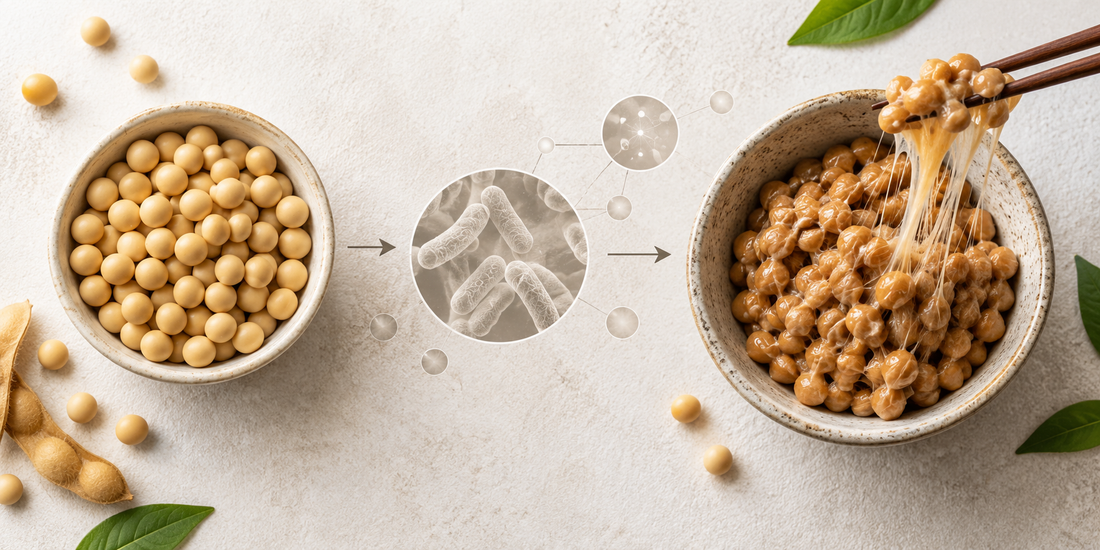
Traditional natto is produced by cooking soybeans and fermenting them with Bacillus subtilis var. natto. The bacteria grow on the soybeans and carry out a range of metabolic processes as they ferment the food.
One of the compounds produced through these microbial processes is menaquinone-7 (MK-7).
In other words, the soybean doesn't simply contain a fixed amount of MK-7 that remains unchanged.
The microorganisms involved in natto fermentation have the ability to biosynthesize MK-7.
Research into Bacillus subtilis has shown that the organism possesses the biochemical machinery required for MK-7 production, which is why this bacterium is widely studied for microbial vitamin K2 production.
This gives us a useful way to think about natto:
Soybeans + fermentation microorganisms + controlled fermentation = a food with a very different biochemical profile from the original soybean.
What actually changes during fermentation?
Fermentation is not just about adding bacteria to food and waiting.
As Bacillus subtilis grows, it produces enzymes and metabolites that change the food's physical, chemical and sensory characteristics.
During natto fermentation, researchers have observed changes involving:
- proteins and peptides
- amino acids
- isoflavone forms
- flavour compounds
- texture and viscosity
- bioactive compounds
- menaquinones such as MK-7
The bacteria essentially use the soybean as a nutrient-rich environment in which they grow and carry out their metabolism.
That microbial activity is responsible for many of the characteristics we associate with natto—including its characteristic sticky texture and aroma.
And importantly, MK-7 production is also influenced by the conditions under which the bacteria ferment.
Why does fermentation conditions matter for MK-7?
This is one of the most interesting areas of current natto research.
The amount of MK-7 produced by Bacillus subtilis is not necessarily fixed. Researchers have investigated factors such as:
- bacterial strain
- nutrient availability
- oxygen supply
- fermentation time
- temperature
- biofilm formation
- fermentation strategy
For example, previous research has shown that oxygen availability can influence MK-7 production because Bacillus natto is an aerobic microorganism. Other studies have investigated how nutrient composition and biofilm formation affect MK-7 biosynthesis.
This means that “natto contains MK-7” is only the beginning of the story.
The fermentation process can influence how much is produced.
What does the new 2026 research tell us?
A particularly interesting study published in Food Control in 2026 looked at how fermentation could be optimised to increase MK-7 while also paying attention to food safety and sensory quality.
The researchers used an MK-7-producing strain of Bacillus subtilis var. natto and examined changes in MK-7, biogenic amines, amino acids and flavour-related compounds throughout fermentation.
The study reported an MK-7 concentration of approximately 2.05 mg per 100 g in its experimental group—reported by the researchers as the highest MK-7 content they had identified in natto. This was about 2.86 times higher than the comparison natto group in their experiment.
But the study wasn't simply about maximising a number.
The researchers were also interested in biogenic amines and flavour quality.
That matters because fermentation is a balancing act. Changing microbial strains or fermentation conditions can influence not only desirable compounds but also compounds that may affect food safety, aroma and taste.
The study reported that its fermentation strategy maintained the measured biogenic amines within the safety thresholds considered by the researchers, while also improving aspects of natto's flavour and quality.
The bigger takeaway?
More MK-7 isn't the only goal.
Good fermentation needs to balance nutritional composition, microbial activity, food safety and sensory quality.
That is what makes fermentation science so fascinating.
Why is natto especially associated with MK-7?
Menaquinones occur in a variety of foods, particularly fermented foods, but natto stands out because of its particularly high MK-7 content.
Vitamin K research distinguishes MK-7 from other menaquinones based on its molecular structure, and MK-7 is one of the longer-chain forms of vitamin K2.
Natto's association with MK-7 comes largely from the activity of its fermentation microorganism, Bacillus subtilis var. natto.
This is also why simply saying “soy contains vitamin K2” misses an important part of the story.
The interesting chemistry happens during fermentation.
Natto is more than nattokinase
Natto is often marketed and discussed primarily around nattokinase, the enzyme associated with the fermented soybean food.
But natto is a much more complex food.
It contains a combination of:
Soybean nutrients + microbial metabolites + enzymes + fermentation-derived compounds.
Among these is vitamin K2 in the MK-7 form.
Research reviews have identified vitamin K2, nattokinase, isoflavones and other compounds as components of natto's nutritional profile.
This is one reason it is useful to look at natto as a whole fermented food, rather than reducing it to a single compound.
What this means for whole-natto foods
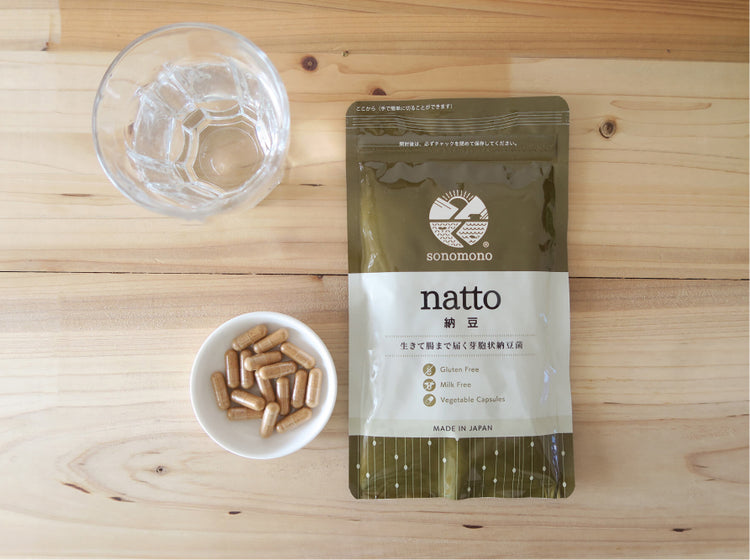
At Sonomono, our interest in natto starts with the whole food.
Sonomono's whole-natto positioning reflects the idea that natto is more than an isolated ingredient or a single headline compound. Its nutritional character comes from the soybeans and the fermentation process that transforms them.
At the same time, it is important not to make a blanket claim that every natto product—or every batch of a particular product—contains the exact MK-7 concentration reported in a research study.
The 2026 Food Control research was performed under specific experimental fermentation conditions and with specific bacterial strains. Its measured MK-7 concentration should therefore be understood as a research finding, not as a universal value for all natto.
For any specific product, the actual MK-7 content should be established through appropriate product-specific analytical testing.
From soybean to MK-7: the simple version
If we strip the science down to one pathway, it looks like this:
Soybeans
↓
Cooking / preparation
↓
Inoculation with Bacillus subtilis var. natto
↓
Controlled fermentation
↓
Microbial metabolism & transformation
↓
Production of compounds including MK-7
↓
Natto
The fascinating part is that fermentation doesn't merely preserve the soybean.
It changes it.
And MK-7 is one of the clearest examples of how microorganisms can transform the nutritional chemistry of a food.
The science is still evolving
Natto has been consumed for generations, but modern food science is allowing researchers to look much more closely at what happens during fermentation.
Current research is exploring how bacterial strains, oxygen, nutrients, biofilms and fermentation conditions can influence MK-7 production.
The 2026 Food Control study adds another layer by showing that optimising fermentation isn't simply about producing more MK-7—it also involves managing biogenic amines and maintaining desirable flavour and food quality.
That makes natto an interesting example of food microbiology in action.
A humble soybean goes into the fermentation process.
A very different food comes out.
Research & further reading
- 2026 — Food Control: Menaquinone-7 enhancement, coordinated control of biogenic amines, and flavor modulation in natto: Development of a food safety-oriented fermentation strategy.
- 2021 — Review: Advances in Enhanced Menaquinone-7 Production From Bacillus subtilis.
- 2024 — Food Microbiology: Research examining how soy protein hydrolysates and biofilm formation can influence MK-7 biosynthesis by Bacillus subtilis natto.
- NIH Office of Dietary Supplements: Vitamin K overview and information on K1 and menaquinones.