How to Evaluate a Nutrition Study Before Sharing It
Nutrition headlines can make research sound more conclusive than it really is. Use this practical checklist to assess a study’s research question, design, sample size, comparison group, duration, outcomes, limitations and funding before deciding what its findings actually mean.
How to Evaluate a Nutrition Study Before Sharing It
A headline claims that a particular food supports heart health. Another suggests that a supplement improves gut health. A third announces that researchers have discovered a surprising link between a nutrient and a disease.
Nutrition research can provide valuable insights, but headlines and social media posts often simplify what a study actually found. A result may come from a small experiment, a short-term measurement or an observational association rather than evidence that a food or supplement causes a health benefit.
Learning how to evaluate nutrition research helps you separate interesting findings from strong evidence. You do not need to be a scientist or understand every statistical method. You can start by asking a few structured questions about what was studied, how the research was conducted and whether the conclusion matches the results.
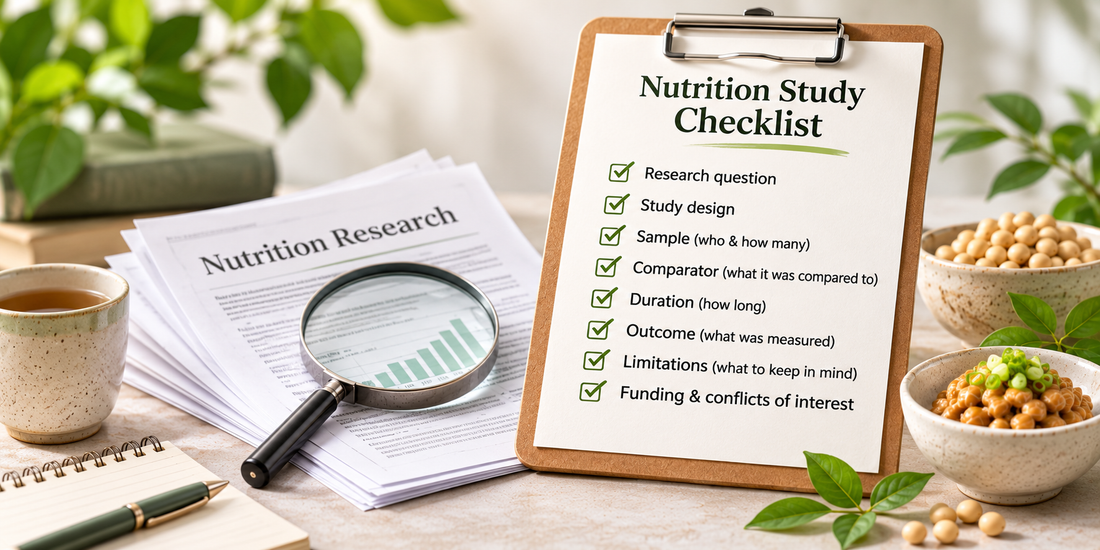
Here is an eight-point checklist you can use before sharing a nutrition claim.
1. What question was the study trying to answer?
Start with the research question, usually described near the end of the introduction.
Try to identify four things:
-
Population: Who or what was studied?
-
Intervention or exposure: What food, nutrient, dietary pattern or supplement was investigated?
-
Comparison: What was it compared with?
-
Outcome: What did researchers measure?
For example, these are three different questions:
-
Is higher dietary fibre intake associated with a lower risk of a particular disease?
-
Does taking a specific fibre supplement change a biological marker over eight weeks?
-
Does increasing fibre-rich foods reduce the incidence of disease over several years?
The questions concern related topics, but they require different types of evidence.
A useful first step is to rewrite the study's objective in one sentence. If you cannot tell what the researchers set out to investigate, be cautious about accepting a broad conclusion based on the paper.
2. What type of study was it?
Study design determines what conclusions the research can reasonably support. No single design is ideal for every question.
Common nutrition study designs
Observational studies
Researchers observe people's diets, behaviours or health outcomes without assigning them to a particular diet or intervention. Cohort studies follow groups over time, while cross-sectional studies examine information at a particular point.
These studies can identify patterns and associations, but confounding factors may explain some or all of the relationship.
Randomised controlled trials
Participants are assigned to different interventions by chance. When appropriately designed and conducted, these trials can provide stronger evidence about whether an intervention causes a particular outcome.
However, randomisation does not automatically eliminate every source of bias, and the findings still depend on adherence, study duration, outcome measurement and other methodological factors.
Systematic reviews and meta-analyses
Systematic reviews use predefined methods to identify and assess relevant research. Meta-analyses statistically combine results when the studies are sufficiently comparable.
A review is not automatically reliable simply because it includes many studies. The quality of the underlying evidence, the methods used to select studies and differences between studies all matter.
Laboratory and animal studies
These can help researchers investigate mechanisms and generate hypotheses. They do not, by themselves, establish that the same effects occur in people consuming a food or supplement.
The key question is not whether a study sounds scientific, but whether its design is appropriate for the claim being made.
3. Who participated, and how large was the sample?
A study's participants determine how relevant its findings may be to other people.
Check the following:
-
How many participants were enrolled and how many completed the study?
-
What were their ages and other relevant characteristics?
-
Were they generally healthy, or did they have a particular medical condition?
-
How were they recruited?
-
Were important groups excluded?
-
Were participants representative of the population discussed in the headline?
Sample size also matters, but bigger is not always better. A large study can still have inaccurate measurements or substantial bias, while a small, carefully conducted study may provide useful early evidence.
Look for whether researchers justified their sample size and whether the number of participants was sufficient to detect the effect they wanted to investigate. A study with few participants may miss a real effect, and its estimates may be imprecise.
Be especially cautious when a result from a narrow group is presented as though it applies to everyone. Findings in adults with a particular condition, for example, may not transfer directly to healthy adults, children or older people.
4. What was the comparison group?
A study's results are meaningful only in relation to what participants were compared with.
A supplement trial might compare a product with a placebo. A dietary study might compare one eating pattern with another. An observational study might compare people with higher and lower reported intakes of a food.
Ask whether the comparison is fair and informative.
Were the groups similar at the beginning? Did they receive similar attention from researchers? Were other aspects of their diets or lifestyles likely to differ? In a trial, were participants randomly assigned, and were the people assessing outcomes blinded where appropriate?
The comparator can also influence the interpretation of the result.
If a food is compared with no intervention, the findings may differ from a comparison with another nutritious food. Likewise, a supplement that performs better than a placebo has not necessarily been shown to be better than obtaining the relevant nutrient through food.
Always identify what the study actually compared before repeating a claim about effectiveness.
5. How long did the study last?
Duration should match the question being investigated.
A short study may be appropriate for measuring a change in a nutrient's absorption, a blood marker or a digestive response. It may be inadequate for determining whether a dietary intervention changes the long-term risk of developing a disease.
Check:
-
How long did participants receive the intervention or have their diets assessed?
-
How long were they followed?
-
Were participants lost to follow-up?
-
Was the study long enough to measure the outcome highlighted in the headline?
A study lasting a few weeks might report a change in a laboratory measurement. That does not establish whether the change persists or translates into a meaningful long-term health outcome.
Duration also affects observational research. A dietary questionnaire completed once may not accurately represent what someone eats over many years.
A study's duration is not automatically a weakness. The important question is whether it was appropriate for the outcome being investigated.
6. What did researchers actually measure?
This is one of the most important checks because headlines often turn a narrow result into a broad health claim.
Nutrition studies can measure several different types of outcomes:
Composition or laboratory measurements: For example, the amount of a nutrient in a food or the activity of an enzyme under laboratory conditions.
Biomarkers: Measurements such as blood lipid levels or other biological indicators that may relate to health.
Intermediate outcomes: Changes in body weight, blood pressure or other measures that may help researchers understand potential health effects.
Clinical outcomes: Events or outcomes that directly matter to health, such as a heart attack, disease diagnosis or hospitalisation.
These outcome types are not interchangeable. A biomarker may be informative without proving that an intervention prevents disease.
Also check whether the reported outcome was the study's primary outcome—the main result the researchers planned to evaluate—or a secondary or exploratory finding.
Studies may measure many outcomes. Some may show a difference while others do not. If a headline highlights only one positive result, read the paper to understand the full set of findings.
Look beyond statistical significance
A result described as statistically significant does not automatically mean it is large, important or clinically meaningful.
Check the size of the effect and, where available, its confidence interval. Consider the absolute difference as well as the relative change.
For example, a relative reduction of 50% could mean a change from 2 events to 1 event per 100 people, or from 20 events to 10 events per 100 people. The relative reduction is identical, but the absolute difference is not.
The numbers in this illustration are hypothetical. The point is to ask what the reported effect means in practical terms.
7. What are the limitations, and who funded the research?
Every study has limitations. Recognising them is part of interpreting evidence, not a reason to dismiss research automatically.
Look in the discussion section for issues such as:
-
Small sample size or imprecise estimates
-
Self-reported dietary intake and possible recall errors
-
Missing data or participants dropping out
-
Short follow-up
-
Potential confounding factors
-
Lack of blinding where it would have been relevant
-
Results that may not generalise to other populations
-
Multiple outcomes or subgroup analyses
-
Uncertainty about whether the findings can be reproduced
Then review the funding and conflict-of-interest statements.
Who paid for the study? Did a company supply the product? Did the funder have a role in the design, analysis or reporting? Did the authors disclose relevant financial or professional relationships?
Commercial funding does not automatically make a study unreliable, just as public funding does not guarantee quality. These details are part of assessing the study's context and potential sources of bias.
Finally, check whether the authors' conclusion matches their data. If a study reports an association, the conclusion should not imply that causation has been established without adequate supporting evidence.
8. Does the evidence support the claim being shared?
Before sharing a post, compare its wording with the paper's actual findings.
A useful distinction is between what the researchers observed and what someone claims the result means.
For instance:
-
Measured finding: A particular intervention changed a specified blood marker during the study.
-
Stronger claim: The intervention prevents a disease.
-
Even broader claim: Everyone should take the intervention to improve their health.
Each step makes a broader claim and requires evidence to support it.
Also check whether the headline refers to the same food, formulation, dose, population and outcome that were studied. Results from a whole food do not automatically establish the effects of a concentrated extract or supplement. Similarly, an isolated ingredient's laboratory activity does not prove that consuming a product containing it will deliver a health benefit.
When possible, read the original research paper rather than relying solely on a press release, news article or social media summary.
Worked example: What can the PREDIMED trial tell us?
The PREDIMED trial provides a useful real-world example of why study appraisal involves more than reading a headline.
In a 2018 corrected and republished report in The New England Journal of Medicine, researchers examined whether Mediterranean diets supplemented with extra-virgin olive oil or mixed nuts were associated with fewer major cardiovascular events than advice to reduce dietary fat. The trial enrolled 7,447 adults aged 55–80 who were at high cardiovascular risk but did not have cardiovascular disease at enrolment. Participants were followed for a median of 4.8 years. The primary outcome was a major cardiovascular event: heart attack, stroke or cardiovascular death.
The corrected report found that primary-outcome events occurred in 3.8% of participants assigned to the olive-oil group, 3.4% in the nut group and 4.4% in the control group. The researchers reported adjusted hazard ratios of 0.69 for the olive-oil group and 0.72 for the nut group compared with the control group.
What does the checklist reveal?
Research question and design: This was a dietary intervention trial with a clinical outcome, making it more informative about the intervention than an observational association alone.
Sample and duration: The study included thousands of older adults at elevated cardiovascular risk and followed them for several years. However, its findings should not automatically be applied to every age group or risk profile.
Comparator: The study compared two Mediterranean-diet interventions supplemented with specific foods against advice to reduce dietary fat. It did not test olive oil or nuts as isolated supplements against every possible alternative diet.
Outcome: Researchers assessed major cardiovascular events rather than relying only on a laboratory marker.
Limitations and research integrity: The trial's original 2013 report was withdrawn after irregularities in randomisation procedures were identified. The investigators then reanalysed the data and published a corrected report in 2018, using approaches that accounted for the protocol deviations. This history is a particularly useful reminder to check corrections and retractions when evaluating influential research.
Funding and interpretation: The paper disclosed public research funding. Its conclusion concerned the specific dietary interventions and the high-risk population studied, rather than proving that any single food or supplement prevents cardiovascular disease in everyone.
The lesson is not that one methodological issue automatically invalidates every finding. It is that research should be evaluated in context, including the methods, the results, the limitations and any subsequent corrections.
You can read the corrected PREDIMED trial report to examine the details directly.
Your nutrition research checklist
Before sharing a nutrition study, ask yourself:
-
Question: What did the researchers want to find out?
-
Design: Was the study observational, experimental, laboratory-based or a systematic review?
-
Sample: Who participated, how many were included and how representative were they?
-
Comparator: What was the intervention compared with?
-
Duration: Was the study long enough to investigate the outcome?
-
Outcome: What was measured, and was it a primary or secondary outcome?
-
Limitations: What sources of bias or uncertainty did the authors identify?
-
Funding: Who supported the research, and were conflicts of interest disclosed?
-
Conclusion: Does the headline accurately reflect what the data show?
-
Context: Do other studies support the finding, and has the paper been corrected or retracted?
For more structured guidance, the National Institutes of Health study quality assessment tools provide design-specific questions for evaluating research. The CONSORT guidelines are useful for understanding the reporting of randomised trials, while the STROBE guidelines cover observational studies.
The bottom line
Nutrition research is most useful when we understand both what it tells us and what remains uncertain. A strong headline is not a substitute for a clear research question, an appropriate design, relevant outcomes and a balanced interpretation of the findings.
Before sharing a nutrition claim, take a few minutes to read beyond the abstract. Check the methods, look at the results, consider the limitations and compare the conclusion with the evidence.
Good research literacy is not about rejecting every new finding. It is about sharing findings accurately, asking better questions and remaining open to what further evidence may show.
Disclaimer: This article is for general educational purposes only. It is not a substitute for personalised medical or nutritional advice.