Food Labels Explained: Ingredients, Serving Size and Reference Values
Food labels contain useful information, but knowing how to interpret them makes all the difference. Learn how to read ingredient lists, understand serving sizes, compare nutrition panels and interpret reference intake values using UK food-labelling guidance.
Food Labels Explained: Ingredients, Serving Size and Reference Values
Food labels provide a useful snapshot of what is inside a packaged product. They can tell you which ingredients were used, how much energy and certain nutrients a food contains, and how a serving compares with general reference values.
However, reading a food label is not always straightforward. A product may display nutrition information per 100g, per serving and as a percentage of an adult's reference intake. Ingredient lists may include unfamiliar names, while front-of-pack colours can make products appear easier to compare than they really are.
Understanding these details can help you make more informed food choices without relying on a single number or marketing statement.
This guide uses general UK food-labelling guidance for prepacked foods. Requirements may vary by product category, and some exemptions apply.
1. Start with the ingredient list
The ingredient list is one of the most useful places to begin when examining a packaged food.
Under UK food-labelling rules, most prepacked foods containing more than one ingredient must display an ingredients list, subject to specified exemptions.
Ingredients are generally listed in descending order of weight at the time they are used in manufacturing. This means the ingredient used in the greatest quantity appears first, followed by the next most abundant ingredient.
What does the order tell you?
Consider this simplified example:
Ingredients: Oats, dried fruit, sunflower seeds, honey, vegetable oil, cinnamon.
This tells you that oats make up more of the product by weight than dried fruit, sunflower seeds or the other listed ingredients.
However, the list does not tell you the exact percentage of every ingredient. For that, you may need to look for a quantitative ingredients declaration, often called QUID.
What is QUID?
QUID stands for Quantitative Ingredients Declaration. It gives the percentage of certain ingredients or categories of ingredients in a food.
It is generally required in particular circumstances, such as when an ingredient appears in the name of the food, is emphasised on the label through words or images, or is essential to characterising the product.
For example, if a product is marketed as a strawberry yoghurt, the quantity of strawberry may need to be declared.
QUID can help you understand how much of a highlighted ingredient is actually present, rather than relying only on its prominence in the product name or packaging.
2. Pay attention to allergens
Ingredient lists also provide important information about allergens.
UK food-labelling rules require the relevant allergens among the 14 regulated allergen categories to be emphasised in the ingredients list when they are present as ingredients. This is commonly done using bold text, a different font or another clear visual treatment.
The 14 categories include:
-
Cereals containing gluten, such as wheat, barley and oats
-
Crustaceans
-
Eggs
-
Fish
-
Peanuts
-
Soybeans
-
Milk
-
Nuts
-
Celery
-
Mustard
-
Sesame seeds
-
Sulphur dioxide and sulphites above the specified threshold
-
Lupin
-
Molluscs
For example, a cereal bar might list oats, honey, PEANUTS and dried fruit, with peanuts emphasised to make the allergen easier to identify.
Always read the full allergen information rather than relying on assumptions based on a product's name or appearance. If you have a food allergy, check the current packaging each time you buy a product, as ingredients and manufacturing information can change.
The UK government food-labelling guidance explains ingredient-list and allergen requirements in more detail.
3. Understand the nutrition information panel
The nutrition panel provides information about the energy and nutrients in a food.
For most prepacked foods requiring a nutrition declaration in the UK, the mandatory information includes:
| Nutrient | What it tells you |
|---|---|
| Energy | The amount of energy provided, shown in kJ and kcal |
| Fat | Total fat content |
| Of which saturates | The amount of saturated fat |
| Carbohydrate | Total carbohydrate content |
| Of which sugars | The amount of sugars within the carbohydrate content |
| Protein | Protein content |
| Salt | Salt content |
Some products are exempt from mandatory nutrition labelling, while additional information may be required or provided voluntarily in particular circumstances.
What is the difference between carbohydrate and sugars?
Carbohydrate is a broader category that includes sugars, starches and, depending on the applicable definition and presentation, other carbohydrate components.
The line marked "of which sugars" shows the amount of sugars included within the total carbohydrate figure.
For example, a food might contain 30g of carbohydrate per 100g, of which 8g are sugars. The remaining carbohydrate is not necessarily sugar; it may include starch and other carbohydrate components.
This distinction is useful when comparing foods that contain different types of carbohydrate.
What does salt tell you?
The salt value represents the declared salt content, not simply the amount of salt added during cooking.
It may include sodium naturally present in ingredients as well as sodium from added salt and other sodium-containing ingredients.
A food can therefore contain salt even when salt does not appear as a separately added ingredient.
4. Why is nutrition information shown per 100g or 100ml?
One of the most useful features of UK nutrition labelling is the standardised per-100g or per-100ml presentation.
It provides a common basis for comparing products, even when their recommended or typical serving sizes differ.
For example, imagine two breakfast cereals:
| Nutrient per 100g | Cereal A | Cereal B |
|---|---|---|
| Energy | 370 kcal | 390 kcal |
| Fat | 5g | 7g |
| Sugars | 12g | 18g |
| Fibre | 9g | 6g |
These are hypothetical figures for illustration.
Comparing the values per 100g helps you see the differences between the products without allowing different serving suggestions to influence the comparison.
However, per-100g information does not tell you how much you will consume in a typical bowl. For that, you also need to consider the portion you actually eat.
5. What does serving size mean?
A serving size is the amount of food used to calculate the nutrition information for a stated portion.
On some products, the manufacturer may provide an example serving, such as:
-
30g of breakfast cereal
-
150g of yoghurt
-
Two biscuits
-
One slice of bread
Serving sizes can make nutrition information more practical because most people do not eat exactly 100g of every food.
However, a suggested serving is not necessarily the amount everyone consumes.
For example, suppose a cereal label gives the following hypothetical values:
| Nutrient | Per 100g | Per 30g serving |
|---|---|---|
| Energy | 380 kcal | 114 kcal |
| Fat | 6g | 1.8g |
| Sugars | 15g | 4.5g |
| Protein | 10g | 3g |
If you eat 60g rather than 30g, you consume twice the amount shown in the serving column.
This is why it is useful to check both the per-100g values and the portion information.
A practical tip: If you regularly eat more or less than the suggested serving, use the per-100g values to estimate what your actual portion contains.
6. What are Reference Intakes (RIs)?
Reference Intakes, often shown as percentages on food packaging, provide a general benchmark for the amount of energy and certain nutrients an average adult is advised to consume in a day.
On UK food labels, the reference intake for energy is generally shown as:
8,400 kJ / 2,000 kcal per day
This is a standard reference value used for food-labelling purposes. It is not an individual calorie requirement or a personalised nutrition target.
For example, if a serving of food provides 10% of an adult's reference intake for energy, it means that the serving contributes one-tenth of the stated reference value.
The percentage does not mean that the food is automatically healthy or unhealthy. It simply indicates how the stated portion compares with the reference figure.
How should you interpret % RI?
Imagine a hypothetical snack label showing:
-
Energy: 150 kcal — 8% RI
-
Fat: 6g — 9% RI
-
Saturates: 2g — 10% RI
-
Sugars: 8g — 9% RI
-
Salt: 0.3g — 5% RI
These percentages provide context for the serving, but they should not be treated as a personalised assessment.
Individual energy and nutrient requirements vary with factors such as age, body size, activity, health circumstances and other dietary needs.
Reference Intakes are therefore best understood as a general comparison tool rather than a precise measure of what an individual should consume.
7. What do front-of-pack colours mean?
You may notice traffic-light colours on the front of some UK food packages.
This is a voluntary front-of-pack nutrition labelling scheme used by many manufacturers. It provides a quick visual indication of the levels of selected nutrients, commonly:
-
Fat
-
Saturates
-
Sugars
-
Salt
The colours generally indicate:
-
Green: Low level
-
Amber: Medium level
-
Red: High level
The classification is based on defined criteria, which can differ depending on the food or drink category.
The system is intended to make it easier to compare products at a glance. However, it does not replace the full nutrition panel.
A product with a red indicator is not automatically unsuitable for consumption. Equally, a product with several green indicators is not necessarily nutritionally complete.
For a more informed comparison, look at the ingredients, the full nutrition information and the portion you are likely to eat.
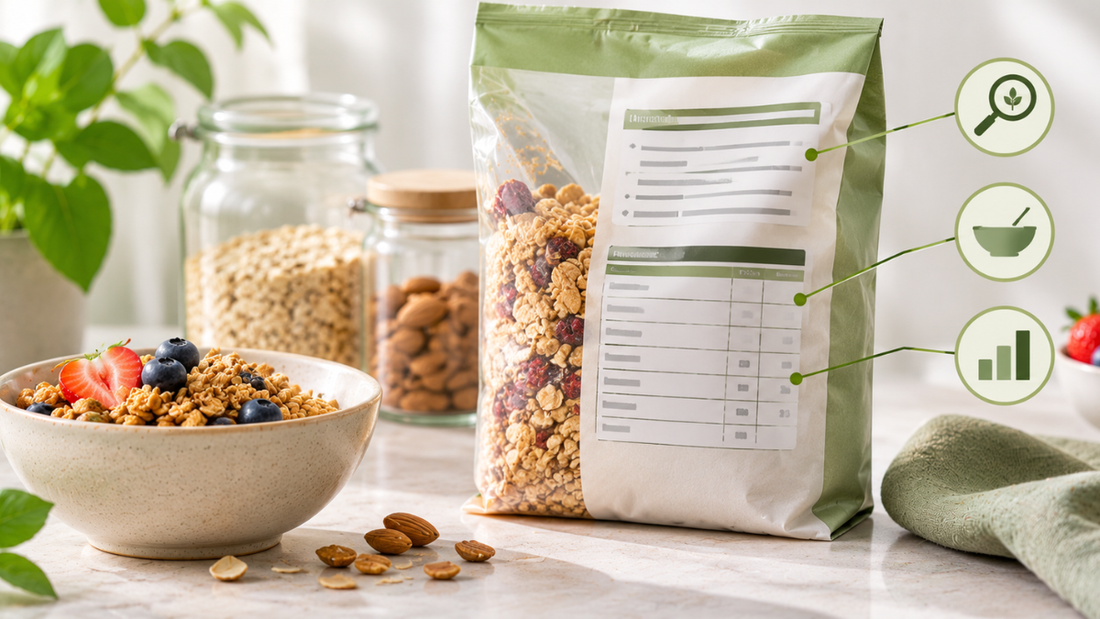
8. A simple example: Reading a food label from top to bottom
Imagine you are comparing two packaged granola products.
Instead of looking only at the front of the packaging, follow this sequence:
Step 1: Check the product name.
Does the name accurately describe the food? Is it a granola, cereal bar or another type of product?
Step 2: Read the ingredients.
Which ingredients appear first? Are nuts, dried fruit or sweeteners included? Is the quantity of a highlighted ingredient declared where required?
Step 3: Check allergens.
Look for emphasised allergen information and any relevant precautionary statements.
Step 4: Compare the nutrition panels per 100g.
Check energy, fat, saturates, carbohydrate, sugars, protein and salt.
Step 5: Look at the serving size.
Does the suggested portion reflect how much you would normally eat?
Step 6: Interpret the reference intake.
Use the percentage as a general benchmark, not as a personalised daily target.
This approach gives you a more complete understanding of the product than relying on a single front-of-pack claim.
9. What food labels cannot tell you
Food labels are useful, but they do not answer every nutrition question.
For example, a nutrition panel does not necessarily tell you:
-
Exactly how much of every individual compound is present
-
How much of a nutrient a particular person will absorb
-
How a food will affect an individual's health
-
Whether a product is suitable for every dietary or medical requirement
-
The complete effect of processing on the food's structure
-
How the product fits into an individual's overall dietary pattern
A nutrition label is primarily a standardised way to communicate product information. It should not be interpreted as proof of a particular health outcome.
If you want to understand a specific ingredient or food-processing method in more depth, look for relevant research and consider what the research actually measured.
The bottom line
Reading food labels is less about finding a single number and more about understanding how the different pieces of information fit together.
Start with the ingredient list, check allergen information, compare nutrition values per 100g or 100ml, and then consider the serving size and Reference Intake percentages.
Most importantly, remember that reference values are general benchmarks, not personal targets, and nutrition panels cannot explain every aspect of a food's nutritional or health effects.
A little attention to the details can make food labels much easier to interpret—and help you make more informed comparisons.
Educational disclaimer: This article is for general informational purposes only and is not intended to replace personalised medical or nutritional advice. Always consult the relevant official guidance for product-specific food-labelling requirements.