FU vs mg: How to Read a Nattokinase Supplement Label
Shopping for nattokinase supplements? Learn why milligrams and fibrinolytic units (FU) measure different things, how to compare labels, and what to check about natto powder, vitamin K2, ingredients, soy allergens and medication interactions.
FU vs mg: How to Read a Nattokinase Supplement Label
If you've ever compared nattokinase supplements, you've probably noticed that some labels highlight milligrams (mg), while others prominently display fibrinolytic units (FU).
At first glance, these numbers can make products seem easy to compare. A supplement listing 200 mg might appear to offer more than one listing 100 mg, while a product advertising 4,000 FU might look stronger than one listing 2,000 FU.
But these figures measure different things.
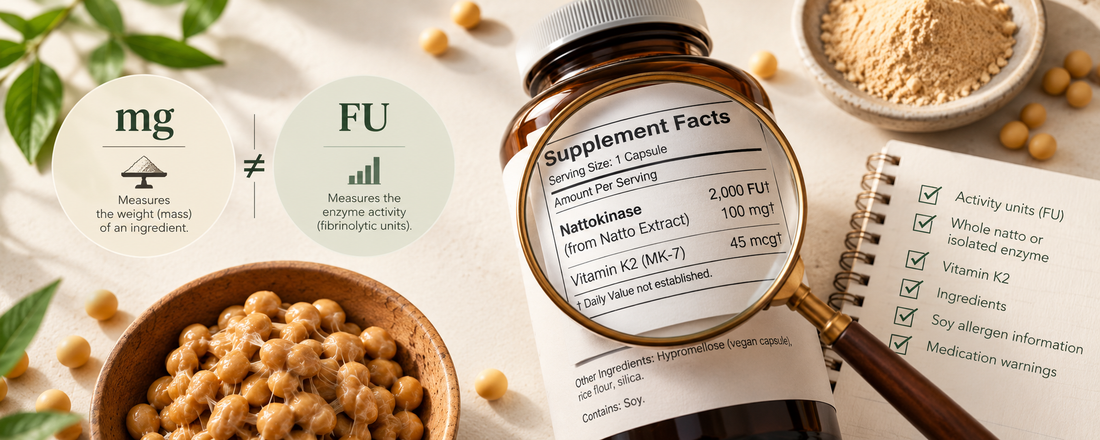
Milligrams measure weight. FU measures enzyme activity. Understanding this distinction is one of the most useful first steps when comparing nattokinase products.
It is also worth looking beyond the headline number. The source of the ingredient, whether the product contains whole natto powder or isolated nattokinase, its vitamin K2 content, other ingredients, allergen information and safety warnings all deserve attention.
Here's how to read a nattokinase supplement label with greater confidence.
1. What does mg mean on a nattokinase label?
Milligrams, written as mg, are a unit of mass.
When a supplement label lists 100 mg, it tells you the mass of the ingredient or material specified on that label. However, it is important to check exactly what the milligrams refer to.
For example, a product might list:
-
100 mg of nattokinase
-
100 mg of natto extract
-
100 mg of freeze-dried natto powder
These descriptions are not interchangeable.
A milligram measurement of whole natto powder refers to the mass of the powder, which contains a mixture of food components. A milligram measurement of an isolated enzyme ingredient refers to the mass of that ingredient.
Neither figure alone tells you the enzyme activity of the material.
This is why comparing products solely by milligrams can be misleading.
2. What does FU mean?
FU stands for fibrinolytic units, a measure of the fibrinolytic activity of nattokinase preparations.
Nattokinase is an enzyme produced during the fermentation of soybeans used to make natto. It has been studied for its ability to break down fibrin, a protein involved in blood clot formation.
Unlike milligrams, FU is intended to describe measured activity rather than mass.
A supplement label that lists 2,000 FU is providing an activity figure for the specified serving or ingredient, depending on how the label is written.
When comparing products, check whether the figure refers to:
-
One capsule
-
A serving of multiple capsules
-
The total daily serving
-
The nattokinase ingredient or a larger ingredient preparation
Always compare equivalent serving sizes.
A label displaying 2,000 FU per capsule is not directly comparable with a label displaying 2,000 FU per two-capsule serving without accounting for the difference.
3. Why you cannot directly convert mg into FU
There is no universal conversion between milligrams and fibrinolytic units.
The relationship depends on the specific preparation, its enzyme activity and the method used to measure that activity.
Consider an example from a US dietary supplement label recorded in the National Institutes of Health Dietary Supplement Label Database.
The label for one isolated nattokinase product lists 100 mg of nattokinase alongside 2,000 FU.
That is useful information about that particular preparation. It does not establish that every 100 mg of nattokinase, natto extract or natto powder will provide 2,000 FU.
Another preparation could have a different activity per milligram.
The practical rule: compare FU with FU and mg with mg, and verify what each number describes. Do not assume one can be calculated from the other.
Reference: NIH Dietary Supplement Label Database — nattokinase product label.
4. Whole natto powder vs isolated nattokinase: what's the difference?
Not all supplements derived from natto are designed to deliver the same ingredients.
Two broad product formats are worth distinguishing.
Whole natto powder
Whole natto powder is made by drying fermented soybeans into a powder. Depending on the manufacturing process, it may retain a broader mixture of soybean components and fermentation-derived compounds.
Its composition can include protein, other soybean constituents and compounds produced during fermentation. Vitamin K2 may also be present, but its quantity depends on the material and processing method.
The product's nattokinase activity should not be assumed from the powder weight alone.
For whole natto powder, look for information about the manufacturing process, whether the product contains the whole fermented food, and any available analytical data on enzyme activity and vitamin K2.
Isolated nattokinase
An isolated nattokinase supplement focuses on the enzyme rather than the complete fermented soybean food.
The enzyme may be extracted and purified from fermented soybean material, then formulated into capsules with other ingredients.
These products may provide a clearly stated FU value, making enzyme activity easier to compare when labels use consistent serving sizes and testing methods.
However, an isolated enzyme product should not automatically be assumed to contain meaningful quantities of vitamin K2. Some preparations are specifically processed to remove vitamin K.
Which format is better?
Neither format is universally superior. They serve different product purposes.
If your priority is a clearly quantified nattokinase activity, look for a product with a transparent FU declaration and suitable quality documentation.
If your interest is in a whole fermented soybean product, look for information about the natto powder itself and its composition.
The right comparison depends on what the product actually contains and what you want to understand about it—not simply which number looks larger.
5. Does the product contain vitamin K2?
Vitamin K2, also known as a group of menaquinones, is distinct from nattokinase.
Natto is particularly associated with vitamin K2 in the MK-7 form, which is produced during fermentation by the microorganisms used to make natto.
However, not every supplement derived from natto contains the same amount of vitamin K2.
For example, a whole natto powder may retain vitamin K2, while a purified nattokinase ingredient may be processed to remove it.
When reading a label, look for:
-
An explicit declaration of vitamin K2 or MK-7
-
The amount per serving, if provided
-
Whether the value applies to the finished product
-
Available product-specific testing or a certificate of analysis
If the label does not declare a vitamin K2 amount, do not assume that the product provides a particular dose.
This distinction is especially important for people who take warfarin. Vitamin K intake can affect warfarin treatment, so changes in intake should be discussed with the prescribing healthcare professional.
6. Check the other ingredients
The active ingredient is only one part of a supplement label.
Capsules may also contain materials used to form the capsule, prevent ingredients from clumping or support manufacturing and stability.
Depending on the product, these can include:
-
Hydroxypropyl methylcellulose or other capsule materials
-
Cellulose-based fillers
-
Anti-caking agents
-
Flow agents
-
Other declared active ingredients
Check the full ingredient list rather than relying on the front of the packaging.
If you follow a vegetarian or vegan diet, look for a clear capsule-material declaration and a suitable product statement. Do not assume that every capsule is plant-based.
If you have allergies or sensitivities, check both the active ingredient and the excipients.
7. Look carefully at soy allergen information
Natto is made from soybeans, so soy is an important consideration when comparing natto-derived products.
The way a manufacturer processes an ingredient may affect what remains in the finished product, but a label statement about processing does not automatically mean a product is safe for everyone with a soy allergy.
Check the allergen declaration and contact the manufacturer if the information is unclear.
If you have a diagnosed soy allergy, seek appropriate medical advice before using a natto-derived supplement.
8. Safety warnings matter as much as the activity number
Nattokinase has biological activity related to fibrin breakdown and has been studied for effects on coagulation and fibrinolysis. That is also why medication interactions deserve attention.
Clinical evidence for nattokinase's health effects remains limited for many proposed uses, and it should not be used as a replacement for prescribed treatment.
In particular, nattokinase may increase bleeding risk when taken with anticoagulant, antiplatelet or other medicines that affect blood clotting.
Speak with a healthcare professional before using nattokinase if you:
-
Take warfarin or another anticoagulant
-
Take aspirin or another antiplatelet medicine
-
Have a bleeding disorder
-
Have a history of significant clotting problems
-
Are preparing for surgery or an invasive procedure
-
Are pregnant or breastfeeding, or have another medical condition that may affect supplement safety
Do not stop or replace a prescribed medicine with nattokinase.
Important: People taking warfarin need particular care with vitamin K intake from natto and natto-derived products. Ask the prescribing clinician how to manage your intake consistently and safely.
Safety reference: Memorial Sloan Kettering Cancer Center — Nattokinase.
9. A practical nattokinase label checklist
Before choosing a product, work through this checklist.
Ingredient identity
-
Does the label specify whole natto powder, natto extract or isolated nattokinase?
-
Is the amount expressed in mg, FU or both?
-
Is it clear which ingredient each number describes?
Enzyme activity
-
Is an FU value declared?
-
Is the value per capsule or per serving?
-
Is there information about activity testing or quality control?
Vitamin K2
-
Is vitamin K2 or MK-7 explicitly listed?
-
Is a quantity provided?
-
Is there product-specific evidence supporting the stated amount?
Capsule and other ingredients
-
What is the capsule shell made from?
-
Are fillers and processing aids listed?
-
Is the product suitable for your dietary requirements?
Allergens and safety
-
Is soy clearly declared?
-
Are medication warnings provided?
-
Have you checked potential interactions with a pharmacist or clinician where appropriate?
Manufacturer transparency
-
Is the manufacturer identifiable?
-
Are batch testing, quality standards and product specifications available?
-
Are the claims consistent with the evidence?
This approach gives you a more useful basis for comparing products than simply choosing the largest number on the label.
10. What about Sonomono natto powder capsules?
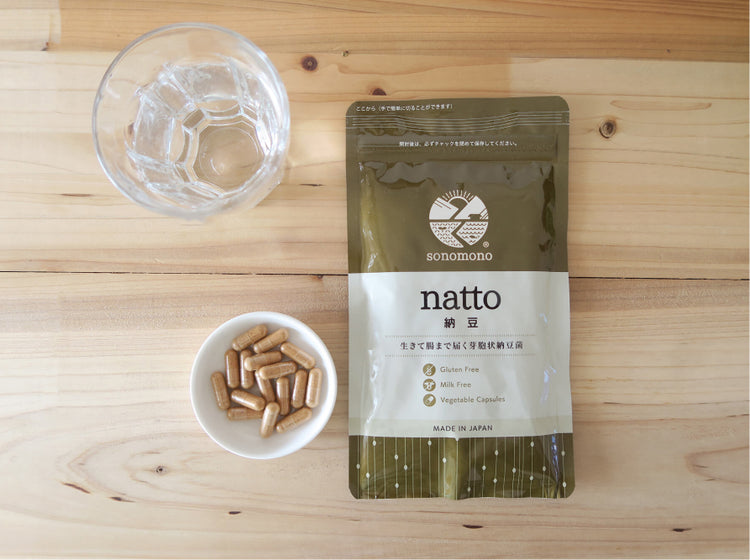
Sonomono focuses on natto powder rather than positioning every product as an isolated nattokinase extract.
That distinction matters when reading the label. Whole natto powder and purified nattokinase are different preparations, so the weight of the powder should not be interpreted as an equivalent amount of isolated enzyme.
If you are considering Sonomono Natto Powder Capsules, review the product information to understand the formulation, ingredients, capsule materials and available nutritional or activity data.
Do not infer a specific FU value or vitamin K2 concentration unless that information is explicitly provided and supported by product-specific testing.
You can learn more about the product here: Explore Sonomono Natto Powder Capsules
Frequently asked questions
Is 2,000 FU the same as 100 mg of nattokinase?
Not universally. Some product labels pair 100 mg with 2,000 FU for a particular preparation, but that does not establish a universal conversion. The relationship depends on the specific ingredient and its measured activity.
Is a higher FU value always better?
No. A higher declared FU value indicates greater measured activity for the specified serving under the relevant test method. It does not automatically establish greater overall quality, better clinical outcomes or greater suitability for an individual.
Does whole natto powder contain nattokinase?
Natto is fermented using Bacillus subtilis var. natto, and nattokinase is associated with the fermentation process. However, the amount and activity retained in a finished powder depend on the manufacturing and processing methods. Check the product's actual specifications.
Does all natto powder contain vitamin K2?
Natto is naturally associated with vitamin K2, particularly MK-7, but the amount in a finished product can vary. Processing and formulation also matter. A product-specific declaration or analytical test is needed to establish the quantity.
Can I take nattokinase with blood thinners?
Do not combine nattokinase with anticoagulant or antiplatelet medicines without medical advice. The combination may increase bleeding risk. People taking warfarin also need to consider the vitamin K content of natto-derived products.
What is the most important number on a nattokinase label?
There is no single number that answers every question. FU helps describe enzyme activity, while mg describes mass. The ingredient identity, serving size, vitamin K2 declaration, allergen information, other ingredients and safety warnings are all relevant.
The bottom line
Reading a nattokinase supplement label becomes easier once you understand the difference between weight and enzyme activity.
Milligrams tell you how much material is present. FU tells you about measured fibrinolytic activity. Neither number, on its own, tells you everything about the product.
Check whether you are looking at whole natto powder or isolated nattokinase, whether vitamin K2 is declared, what else is in the capsule, and what the manufacturer says about allergens, quality and safety.
A well-informed comparison starts with transparent product information—not the biggest number on the front of the bottle.
This article is for educational purposes only and is not medical advice. Dietary supplements are not substitutes for prescribed treatment. Consult a qualified healthcare professional before using nattokinase, particularly if you take medicines that affect blood clotting.