Can Natto Powder Influence the Gut Microbiome? Inside the SONOMONO Study
A published study examined how SONOMONO Natto Powder Capsules may influence the gut microbiome over 62 days. Explore the findings on Bifidobacterium and Blautia, why baseline gut bacteria matter, and what the research can—and cannot—tell us.
Can Natto Powder Influence the Gut Microbiome? Inside the SONOMONO Study
The gut microbiome is a complex community of microorganisms that lives in the digestive tract. Diet, lifestyle, age and other factors can influence its composition, which is why researchers are increasingly interested in how everyday foods interact with gut bacteria.
Natto, a traditional Japanese food made by fermenting soybeans, is one food attracting scientific attention. But what happens when natto is consumed in powdered form?
A published study investigated this question using SONOMONO Natto Powder Capsules, examining changes in the relative abundance of selected gut bacteria over approximately two months.
The findings offer an interesting look at natto and the gut microbiome. They also highlight an important point: the response to a food may depend partly on the gut microbiome a person has before they begin consuming it.
Inside the SONOMONO natto powder study
Published in 2022 in the journal Nutrients, the paper was titled “Fluctuations in Intestinal Microbiota Following Ingestion of Natto Powder Containing Bacillus subtilis var. natto SONOMONO Spores: Considerations Using a Large-Scale Intestinal Microflora Database.”
The researchers examined gut microbiota data from people consuming SONOMONO Natto Powder Capsules and compared the findings with a control group that did not consume the product.
The study used 16S rRNA sequencing data to investigate the relative abundance of different bacterial groups in stool samples.
How was the study conducted?
Participants of both sexes were assigned to either a natto capsule group or a control group. The capsule group consumed three SONOMONO Natto Powder Capsules daily for 62 days.
Stool samples were collected at the beginning of the study, after 31 days and after 62 days. The researchers then analysed changes in the gut microbiota over time.
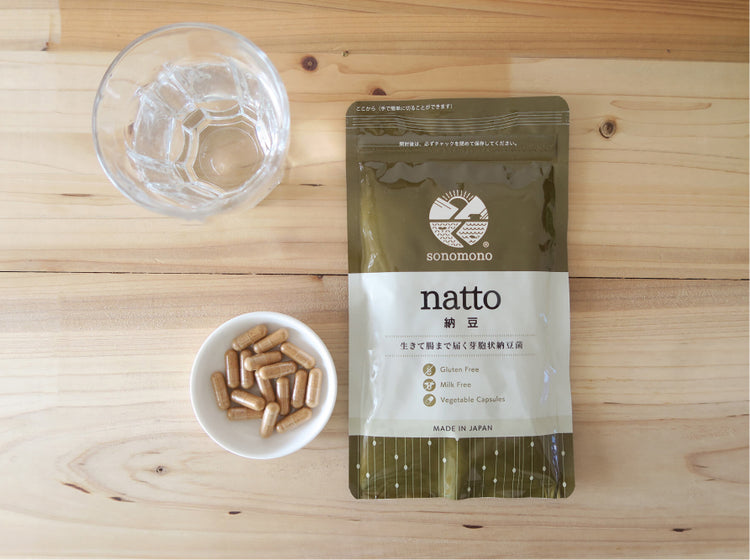
The test product contained freeze-dried natto powder and spores of Bacillus subtilis var. natto SONOMONO.
The researchers also considered participants' background characteristics, including dietary habits and the composition of their gut microbiota at the start of the study.
This design allowed the team to investigate whether the consumption of the capsules was associated with changes in selected gut bacteria—and whether those changes differed between individuals.
Research source: Read the full study in Nutrients.
What did the researchers observe?
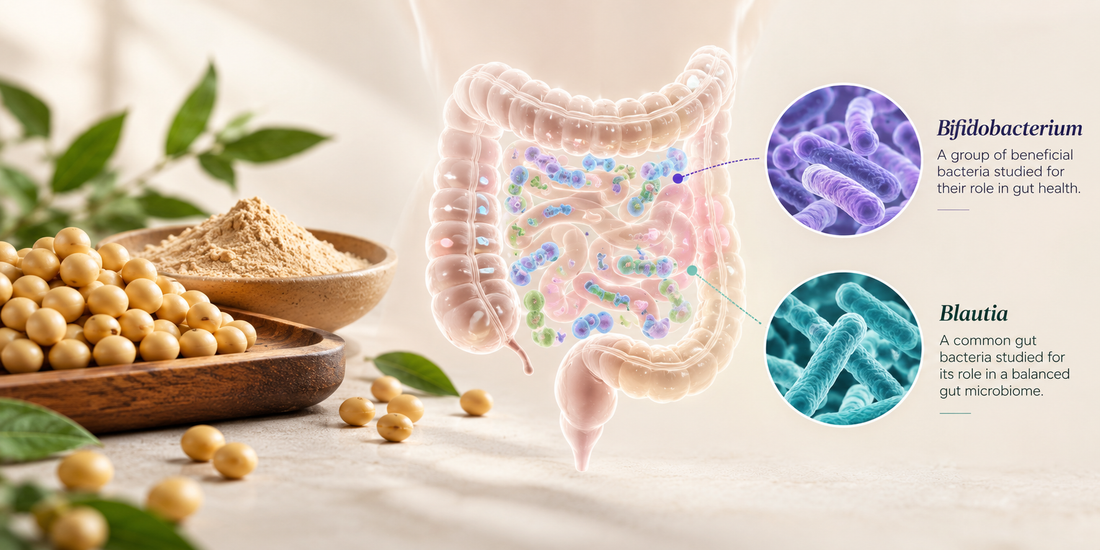
Two bacterial genera received particular attention in the paper: Bifidobacterium and Blautia.
These are different groups of bacteria that researchers study for their roles in the gut microbial ecosystem. The study reported changes in their relative abundance following consumption of SONOMONO Natto Powder Capsules, although the patterns were not identical across participants.
1. Bifidobacterium: a closer look at the findings
Bifidobacterium is a genus of bacteria frequently studied in relation to the human gut microbiome. Different species can use particular dietary carbohydrates and produce metabolites, including organic acids.
In the SONOMONO study, the researchers observed an increase in the relative abundance of Bifidobacterium in the capsule group. The reported pattern was seen in both male and female participants, although the subgroup analyses and comparisons differed.
One particularly interesting observation concerned participants who began the study with relatively low Bifidobacterium abundance.
Among female participants whose baseline levels were below the study group's average, the researchers observed a significant increase during the study. They did not observe the same significant change in the subgroup whose baseline levels were above average.
This suggests that the starting composition of the gut microbiome may be relevant when interpreting how people respond to a food or food-derived product.
However, the finding should not be interpreted as proof that the capsules will increase Bifidobacterium in everyone. The results describe patterns observed in this particular study and need to be investigated further.
2. Blautia: why did the researchers examine it?
Blautia is another bacterial genus found in the human gut. Members of this group participate in microbial metabolism, including the production of certain organic acids.
In the SONOMONO study, the researchers reported an increase in the relative abundance of Blautia in a subgroup of male capsule consumers.
The researchers examined participants whose Blautia abundance increased and compared them with those who did not show the same pattern. Their analyses suggested that the baseline abundance of Bifidobacterium could help explain some of the differences observed between participants.
The findings are interesting because gut microorganisms exist within an interconnected ecosystem. Changes in one group may be associated with the presence or activity of other groups.
Nevertheless, the study did not establish a definitive mechanism explaining the observed changes. Nor did it demonstrate that increasing Blautia necessarily produces a specific health benefit.
The important takeaway is that the response was not uniform: the observed patterns differed according to participants and their starting microbiome characteristics.
Why does your baseline microbiome matter?
Imagine two people following the same dietary routine. Even if they consume the same food, their gut microbiomes may respond differently.
That is because the gut microbiome is shaped by many factors, including:
-
Dietary patterns and the variety of foods consumed
-
Previous exposure to fermented foods
-
Age and other individual characteristics
-
Medication use and lifestyle
-
The existing composition of the gut microbiome
The SONOMONO study adds to research exploring this variability. Its findings suggest that the baseline relative abundance of Bifidobacterium was associated with differences in the changes observed following capsule consumption.
This is a useful reminder that microbiome research is rarely as simple as identifying one universally beneficial bacterium.
A change observed in one group of people should not automatically be expected in every individual.
It is also important to distinguish an association from a proven biological mechanism. Although the researchers proposed possible explanations for their findings, further studies are needed to determine exactly how the product and the existing gut microbial community interact.
What role could natto fermentation play?
Natto is produced by fermenting soybeans with Bacillus subtilis var. natto. Fermentation changes the characteristics of soybeans and contributes to natto's distinctive texture, aroma and nutritional composition.
SONOMONO Natto Powder Capsules use freeze-dried natto powder containing spores of the SONOMONO strain of Bacillus subtilis var. natto.
The study investigated the product as a whole. Its findings should therefore be interpreted in the context of the specific capsule formulation, bacterial strain, intake schedule and study conditions.
It would be premature to attribute every observed change to one isolated component or to assume that all natto foods, powders and supplements will produce identical results.
The research also illustrates why studying a finished product can be valuable: the findings relate to the formulation actually investigated, rather than to natto in general.
What the study does—and does not—prove
The findings are promising as an area for further research, but they need to be interpreted carefully.
What the research supports
-
The researchers observed changes in the relative abundance of selected gut bacterial groups during consumption of SONOMONO Natto Powder Capsules.
-
The patterns involving Bifidobacterium and Blautia differed across participant groups.
-
Baseline Bifidobacterium abundance was associated with some of the differences observed.
-
The study provides product-specific evidence that can inform future research into natto powder and the gut microbiome.
What remains uncertain
-
Whether the observed changes lead to meaningful improvements in digestive health or other clinical outcomes.
-
Whether the same patterns would be observed in larger and more diverse populations.
-
Whether the changes persist after consumption stops.
-
Whether the findings apply to other natto products, formulations or bacterial strains.
-
Whether changes in relative abundance correspond to changes in the absolute number of bacteria.
The last point is especially important. Relative abundance describes the proportion of a microbial group within the measured community. A higher proportion does not necessarily mean that the absolute number of those bacteria has increased.
The study also did not establish that SONOMONO Natto Powder Capsules prevent or treat diabetes, obesity or other diseases. Such conclusions would require appropriate clinical evidence.
Transparency matters: who conducted the research?
The study was published in Nutrients in 2022 and included authors affiliated with Symbiosis Solutions Inc. and sonomono Inc., the company associated with the product.
The paper's conflict-of-interest statement disclosed that one author was the president of sonomono Inc. and another was a part-time employee of the company. It also disclosed that several authors were employees of Symbiosis Solutions Inc., whose president was a co-author.
These affiliations are relevant context when evaluating the findings. They do not automatically invalidate the research, but they are information readers should have when assessing product-related evidence.
Independent replication, larger studies and research using additional methods would help clarify the findings and their wider significance.
Read the original paper: Fluctuations in Intestinal Microbiota Following Ingestion of Natto Powder Containing Bacillus subtilis var. natto SONOMONO Spores.
What this means for Sonomono and whole-natto research
At Sonomono, natto is at the centre of the product story. Research into the finished natto powder offers one way to investigate how a fermented soybean product interacts with the gut microbial community.
The published study provides a starting point for understanding that relationship. It reports changes in selected bacterial groups and highlights how individual baseline microbiomes may influence the patterns researchers observe.
It does not mean that every person will experience the same changes, or that a specific microbiome outcome is guaranteed.
For readers interested in natto, the broader lesson is that fermented foods are complex. Their characteristics depend on the ingredients, microorganisms, processing methods and the way they are consumed.
The scientific picture continues to develop, and careful interpretation is essential as researchers investigate the relationship between food, microorganisms and human health.
Frequently asked questions
Can SONOMONO Natto Powder Capsules change the gut microbiome?
A published 2022 study reported changes in the relative abundance of selected gut bacteria during 62 days of consumption. The findings are preliminary and do not establish that every person will experience the same changes.
What are Bifidobacterium and Blautia?
They are two genera of bacteria found in the human gut. Researchers study their roles in microbial metabolism and their associations with different dietary patterns and health conditions. Their presence or relative abundance alone does not determine a person's overall health.
Why did baseline gut bacteria matter in the SONOMONO study?
The researchers observed different patterns according to participants' starting levels of Bifidobacterium. Some changes were more evident among participants whose baseline abundance was lower, suggesting that initial microbiome composition may influence the results.
Does the study prove that SONOMONO improves digestive health?
No. The study examined changes in gut microbiota composition. It did not establish that those changes necessarily translate into improvements in symptoms, prevention of disease or other clinical outcomes.
Is natto powder the same as eating traditional natto?
Not necessarily. Traditional natto and natto powder products can differ in preparation, formulation and intake. The study investigated a specific freeze-dried capsule product, so its results should not automatically be applied to every natto food or supplement.
The bottom line
The SONOMONO study offers a useful, product-specific contribution to research on natto and the gut microbiome. Its observations involving Bifidobacterium, Blautia and baseline microbiome composition highlight the complexity of the relationship between food and gut bacteria.
The findings are a reason to continue investigating natto powder—not a reason to treat preliminary microbiome changes as proof of a clinical benefit.
Understanding the science means looking at both what a study discovers and what it still leaves unanswered.