What 115 Studies Tell Us About Bacillus subtilis natto and Gut Health
A 2026 review examined 115 studies on Bacillus subtilis and Bacillus natto. Here's what the research says about digestion, the gut microbiome, intestinal immunity and metabolism — and where human evidence is still limited.
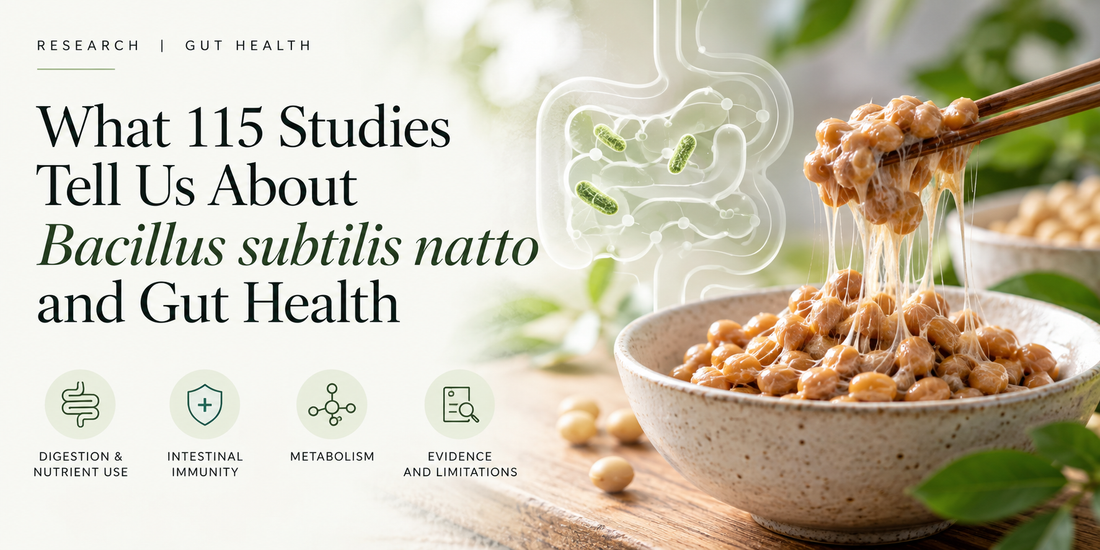
What 115 Studies Tell Us About Bacillus subtilis natto and Gut Health
Natto is often discussed in conversations about fermented foods, vitamin K2 and gut health. But what does the scientific literature actually tell us about the microorganism behind it?
A 2026 review published in Nutrients offers a useful starting point. Researchers reviewed 115 studies published between 2000 and 2025 examining Bacillus subtilis and Bacillus natto across human studies, animal research and model organisms.
The review looked at three broad areas: nutrient digestion and absorption, intestinal immunity, and metabolism. Its findings suggest that Bacillus species have several characteristics that make them interesting as potential probiotic organisms — while also highlighting an important caveat: much of the evidence is still from laboratory and animal research rather than large human clinical trials.
So, what exactly makes Bacillus subtilis var. natto interesting?
What is Bacillus subtilis natto?
Natto is a traditional Japanese food made by fermenting cooked soybeans with a particular bacterium commonly referred to as Bacillus subtilis var. natto.
Unlike many familiar probiotic bacteria, Bacillus can form spores.
Think of a spore as a highly resilient survival state. When environmental conditions become difficult, the bacterium can form a protective structure that helps it withstand stresses such as heat, drying and other environmental conditions.
This characteristic is one reason spore-forming probiotics have attracted scientific interest.
The 2026 review describes Bacillus subtilis and Bacillus natto as particularly resilient compared with many non-spore-forming probiotic organisms. The authors suggest that this resilience may help these organisms survive passage through the gastrointestinal tract and become metabolically active under suitable conditions in the intestine.
That does not mean that every Bacillus product will behave identically. In fact, one of the important messages from the review is that probiotic effects can be strain-specific.
Why does resilience matter?
Many probiotic discussions focus on whether a microorganism can survive long enough to reach the gut.
Spore-forming Bacillus species approach this problem differently.
Their spores provide a protective state that can help them tolerate environmental stresses. According to the 2026 review, Bacillus subtilis spores can survive gastric transit and subsequently germinate under suitable intestinal conditions.
The researchers also describe an interesting proposed mechanism called "oxygen bio-capture."
After germinating, Bacillus subtilis may consume oxygen in the intestinal environment. This could potentially contribute to conditions that are more favourable for certain anaerobic bacteria, including members of the Lactobacillus and Bifidobacterium groups.
This is an interesting biological mechanism — but it is important to distinguish a proposed mechanism from a proven clinical outcome. The existence of a plausible mechanism does not automatically mean that eating natto will produce a particular health benefit in every person.
1. Digestion and nutrient absorption
One of the first areas examined in the review is digestion.
Bacillus subtilis and Bacillus natto can produce a range of enzymes, including enzymes involved in breaking down proteins, carbohydrates and fats.
Much of the research demonstrating these effects comes from animal studies.
For example, studies in poultry have reported changes in digestive enzyme activity and intestinal structure following dietary supplementation with Bacillus natto. Other animal research has examined changes in intestinal villi, digestive enzymes and nutrient transporters.
The review also includes human research. One particularly interesting finding concerns calcium absorption in postmenopausal women, where Bacillus natto consumption was associated with increased calcium absorption.
However, this is an important distinction: evidence that a microorganism can produce digestive enzymes is not the same as proving that consuming natto improves digestion in healthy humans.
The human evidence remains considerably smaller than the body of animal and laboratory research.
2. What about the gut microbiome?
The gut contains a complex community of bacteria and other microorganisms. Fermented foods are particularly interesting because they introduce both microorganisms and fermentation-derived compounds into the diet.
Natto is produced through fermentation by Bacillus subtilis var. natto, and previous research has suggested that consuming natto may influence aspects of the intestinal microbial environment.
For example, a small human study involving natto-containing miso soup reported changes in several bacterial groups and stool metabolites. Another small study found that people with relatively infrequent bowel movements who consumed natto had changes in stool frequency and the proportion of Bifidobacteria compared with boiled soybeans. However, the evidence base remains limited, and some studies have important limitations such as small sample sizes or difficulty separating the effects of natto from other fermented foods consumed alongside it.
The 2026 review takes a broader view, describing interactions between Bacillus, the gut microbiota and host metabolism.
The idea is not simply that one "good bacterium" replaces another. Rather, microorganisms interact with one another and with the environment of the gut.
That distinction matters because the microbiome is an ecosystem, not a simple list of beneficial and harmful bacteria.
3. Gut health and intestinal immunity
The intestine is also an important part of the body's immune system.
Its lining has to perform a difficult balancing act: allowing nutrients to pass through while helping prevent unwanted organisms and substances from crossing the intestinal barrier.
The 2026 review describes research investigating how Bacillus subtilis and Bacillus natto may interact with components of this intestinal barrier.
Research in animals has examined proteins involved in maintaining epithelial tight junctions, mucus production and immune-cell activity. Laboratory studies have also investigated interactions between Bacillus components and immune pathways.
These findings provide possible explanations for how Bacillus organisms could influence intestinal immune responses.
But again, most of these mechanistic findings should not be interpreted as proof that natto prevents infections, "boosts immunity" or treats an intestinal disease.
Those are clinical claims that require appropriately designed human trials.
4. The gut–metabolism connection
Perhaps the most interesting part of the 2026 review is how it connects the gut with wider metabolic processes.
The researchers describe evidence involving the gut–liver and gut–adipose axes.
In animal and cellular research, Bacillus subtilis and Bacillus natto have been associated with changes in microbial composition and metabolic pathways involved in lipid and glucose metabolism.
Researchers have investigated pathways including AMPK, PI3K/AKT and SREBP, as well as targets such as PPAR and CD36.
These pathways are involved in processes including energy metabolism, lipid handling and insulin signalling.
This makes Bacillus an interesting area of research beyond traditional digestive-health discussions.
But these mechanisms should be viewed as areas of scientific investigation rather than established clinical effects of eating natto.
A pathway changing in a cell or animal model does not automatically translate into a measurable health improvement in humans.
So, what does the 115-study review actually tell us?
Perhaps the most useful takeaway is not that natto has suddenly been "proven" to improve gut health.
It hasn't.
Instead, the review shows why researchers are interested in Bacillus subtilis and Bacillus natto.
Across the 115 studies, researchers have investigated three interconnected areas:
Nutrition:
How Bacillus enzymes and their interactions with the intestinal environment may influence digestion and nutrient utilisation.
Intestinal immunity:
How Bacillus and its metabolites or cellular components may interact with the intestinal barrier and immune pathways.
Metabolism:
How changes in gut microorganisms may interact with broader metabolic pathways involving the gut, liver and adipose tissue.
The evidence is strongest as a research story rather than as a universal clinical claim.
Why whole natto is interesting
There is another important distinction when discussing natto.
Natto isn't simply a capsule containing one isolated microorganism.
It is a fermented whole food.
During fermentation, Bacillus subtilis var. natto interacts with soybeans and produces a range of compounds, including nattokinase and vitamin K2. The fermentation process also changes characteristics of the original soybean food.
This makes whole natto particularly interesting from a food-science perspective.
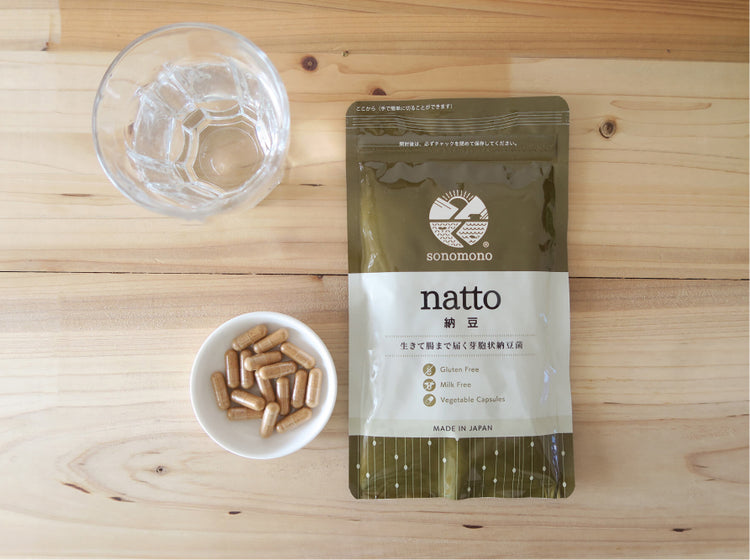
For products such as Sonomono, which use whole natto containing Bacillus subtilis var. natto, the focus can therefore remain on the food and its naturally occurring components rather than making disease-treatment claims.
What we still don't know
The 2026 review itself highlights several important limitations.
First, strain matters.
Two organisms belonging to the same species do not necessarily have identical biological properties. Different Bacillus strains can produce different enzymes, metabolites and biological effects.
Second, a large proportion of the research is conducted in animals, laboratory systems or other models.
Third, human studies remain relatively limited compared with the overall literature.
And fourth, long-term safety and effectiveness need continued investigation.
The review also notes rare reported cases of Bacillus subtilis bacteremia, particularly highlighting the importance of caution in vulnerable or immunocompromised individuals. This is one reason why "natural" or "food-derived" should not automatically be interpreted as "appropriate for everyone."
The bigger picture
Natto sits at an interesting intersection of fermentation, microbiology and nutrition.
The 2026 review doesn't give us a simple answer such as "natto is good for your gut."
Instead, it gives us a more interesting scientific picture.
A resilient spore-forming microorganism can survive challenging conditions. It can produce enzymes and metabolites. It can interact with the intestinal environment and other microorganisms. Researchers are investigating whether those interactions can influence nutrient utilisation, intestinal immune processes and metabolic pathways.
Some human findings are encouraging enough to justify further research, but they are not yet sufficient to turn every proposed mechanism into a health claim.
That distinction is important.
For now, the most accurate way to describe Bacillus subtilis var. natto is as a fascinating organism at the centre of growing research into fermented foods, the gut microbiome and the relationship between the gut and wider metabolic health.
And with 115 studies brought together in one 2026 review, there is certainly plenty more for researchers to investigate.
Read the research
Hua M, Wang J, Li Y, et al. Gut-Centric Multi-System Regulation by Bacillus subtilis and Bacillus natto: A Review of Their Probiotic Functions in Nutrition, Immunity, and Metabolism. Nutrients. 2026;18(5):802.