What Is a Spore-Forming Probiotic? Why Bacillus subtilis natto Is Different
What makes a spore-forming probiotic different? Discover how Bacillus subtilis natto uses protective spores to survive harsh conditions—and why this traditional natto bacterium is attracting modern gut-health research.
What Is a Spore-Forming Probiotic? Why Bacillus subtilis natto Is Different
When you hear the word probiotic, you may think of familiar names such as Lactobacillus or Bifidobacterium. But not all probiotic organisms behave in the same way.
Some bacteria have a remarkable survival strategy: they can form a highly resistant structure called a spore.
One of the best-known examples is Bacillus subtilis, including the strain traditionally associated with natto fermentation, Bacillus subtilis var. natto.
So what exactly is a spore-forming probiotic—and why is it interesting?
What is a spore?
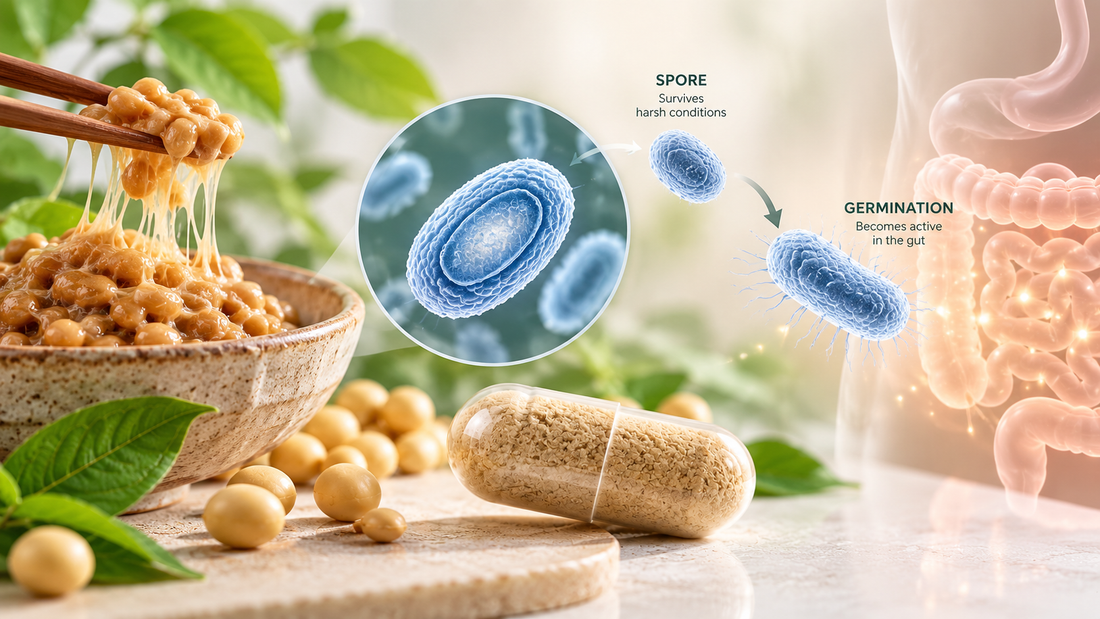
A bacterial spore is essentially a protective survival state.
When conditions become unfavorable, certain bacteria such as Bacillus can switch from their actively growing form into a dormant spore state.
Think of it as putting the bacterial cell into a protective "standby mode."
The spore is highly resistant to environmental stresses that can damage or kill actively growing bacterial cells. When conditions become more favorable again, the spore can germinate and return to an active state.
This ability is one reason spore-forming bacteria have attracted attention in food science and probiotic research.
How are spore-forming probiotics different?
Many commonly studied probiotic bacteria, including species of Lactobacillus and Bifidobacterium, are non-spore-forming organisms.
They remain in their active cellular form and can therefore be more sensitive to factors such as heat, oxygen, moisture, acidity and other environmental stresses.
Bacillus species have a different strategy.
When faced with unfavorable conditions, they can form spores that provide an additional layer of protection.
This doesn't mean that spore-forming probiotics are automatically "better" than other probiotics. Different strains have different characteristics, and probiotic effects are strain-specific.
But the ability to form spores gives Bacillus an interesting advantage from a stability and survival perspective.
What happens when a spore enters the digestive system?
The journey through the digestive system can be challenging for microorganisms.
They encounter changing pH levels, digestive enzymes, bile and other environmental conditions.
Research on Bacillus spores suggests that their resistant structure can help them withstand stressful conditions during gastrointestinal transit.
Under suitable conditions, some spores can then germinate, transitioning back into an active bacterial state.
This survival-and-germination cycle is one of the key features being investigated in research on spore-forming probiotics.
Importantly, survival through the digestive tract does not by itself prove a health benefit. Researchers still need to establish what happens after a particular strain reaches the gut and whether those changes translate into meaningful benefits for people.
Why is Bacillus subtilis natto interesting?
Natto is a traditional Japanese fermented soybean food produced using Bacillus subtilis var. natto.
During fermentation, the bacterium interacts with the soybean substrate and contributes to the transformation of the food.
The resulting natto contains a range of compounds associated with fermentation, including enzymes and other metabolites.
The Bacillus organism itself is also interesting because of its ability to form spores.
This combination—a traditional fermented food plus a naturally spore-forming bacterium—is one reason natto continues to attract attention in food and gut-health research.
What does the latest research say?
A 2026 review published in Nutrients examined research on Bacillus subtilis and Bacillus natto, covering 115 articles published across human studies, animal research and laboratory models.
The review highlighted two characteristics of these organisms in particular:
1. Stress resistance
Their ability to form spores gives them greater resistance to environmental stresses than many non-spore-forming probiotic organisms.
2. Metabolic capacity
The review also highlighted the ability of B. subtilis and B. natto to produce enzymes and other bioactive compounds, which researchers are investigating for their potential roles in nutrient utilization, intestinal function and microbial interactions.
The authors describe these properties as part of the reason Bacillus-based probiotics and fermented foods are receiving increasing scientific interest.
However, the review also makes an important point: much of the evidence comes from animal, laboratory and limited human research, and larger controlled human studies are still needed.
So, while the biology is interesting, it is too early to turn every laboratory finding into a health claim.
Spores don't mean "more powerful"
It's easy to see the word "spore-forming" and assume it means a probiotic is automatically more effective.
That's not how the science works.
A probiotic's effects depend on factors such as:
-
The specific bacterial strain
-
The amount consumed
-
Its ability to survive processing and storage
-
Its ability to survive gastrointestinal conditions
-
Its interaction with the existing gut microbiome
-
The individual's diet and health
-
The specific outcome being studied
In other words, spore formation is a biological characteristic—not a guarantee of a particular health outcome.
Why natto is different from a conventional probiotic blend
Many probiotic supplements are formulated as blends containing multiple selected bacterial strains.
Natto takes a different approach.
It is a fermented whole food, traditionally produced by fermenting soybeans with Bacillus subtilis var. natto.
That makes natto interesting not only because of its bacterial component, but because fermentation itself changes the food matrix and produces a range of compounds.
At Sonomono, this food-first perspective is central to our approach.
Rather than positioning natto simply as another ingredient to add to a conventional multi-strain probiotic formula, Sonomono focuses on natto as a fermented whole-food source and the unique nutritional and fermentation story behind it.
The bigger picture
Spore-forming bacteria such as Bacillus subtilis have a fascinating survival mechanism.
Their ability to form protective spores allows them to withstand environmental stress, remain dormant when conditions are unfavorable, and potentially germinate when conditions become suitable again.
For Bacillus subtilis var. natto, this biology is particularly interesting because it is part of the traditional fermentation process behind natto—a food that has been consumed for generations.
Modern research is now exploring how the organism, its spores and the compounds produced during fermentation may interact with nutrition, the gut microbiome and human health.
But the most useful takeaway is simple:
Spore-forming probiotics are different because they have a built-in survival strategy.
And Bacillus subtilis natto gives us an especially interesting example of how traditional fermentation and modern microbiome research can meet.
Explore the research on natto and gut health
Want to understand more about how Bacillus subtilis found in natto is being studied in relation to the gut?
Read: Probiotics and Gut Health: The Role of Bacillus subtilis in Natto
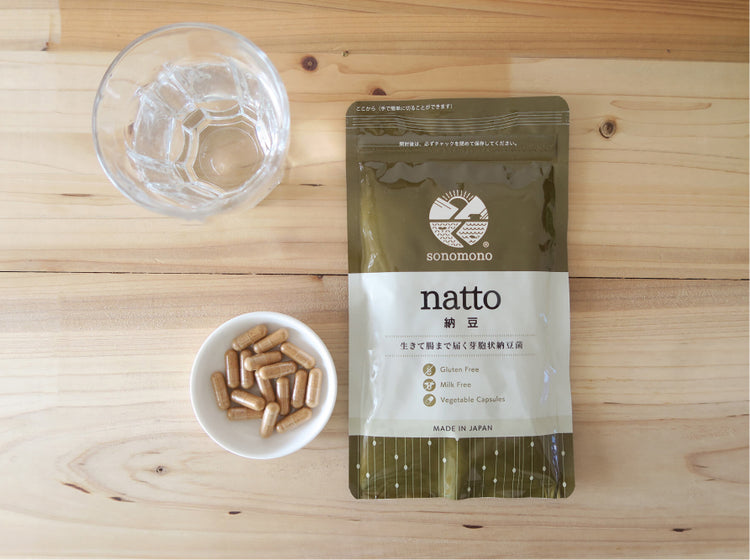
Explore Sonomono Natto Powder Capsules →
A note on the science
Research into Bacillus subtilis and Bacillus natto is still developing. Findings from laboratory and animal studies do not necessarily translate directly into human health benefits, and probiotic effects can vary between strains.
Sonomono is a food-based wellness supplement and is not intended to diagnose, treat, cure or prevent any disease. It should not be used as a substitute for medical advice or prescribed treatment.