What Is the Food Matrix? A Plain-English Guide
The food matrix describes how nutrients and other compounds are organised within a food and interact with one another. Learn why the structure of a whole food matters, how it can influence digestion and nutrient availability, and why findings from isolated compounds do not always apply to foods or supplements.
What Is the Food Matrix? A Plain-English Guide
When we talk about nutrition, we often focus on individual nutrients: protein, fibre, vitamins, minerals, fats and carbohydrates. But food is more complex than a list of numbers on a nutrition label.
A useful concept in nutrition science is the food matrix—the physical structure of a food and the way its nutrients and other compounds are organised and interact.
This helps explain why studying one isolated nutrient does not always tell us everything about the food it comes from. It also highlights why research on a whole food cannot automatically be used to make claims about a supplement containing selected ingredients from that food.
In this guide, we explain what the food matrix means, how it can influence digestion and nutrient availability, and how to interpret research without drawing conclusions beyond the evidence.
What is the food matrix?
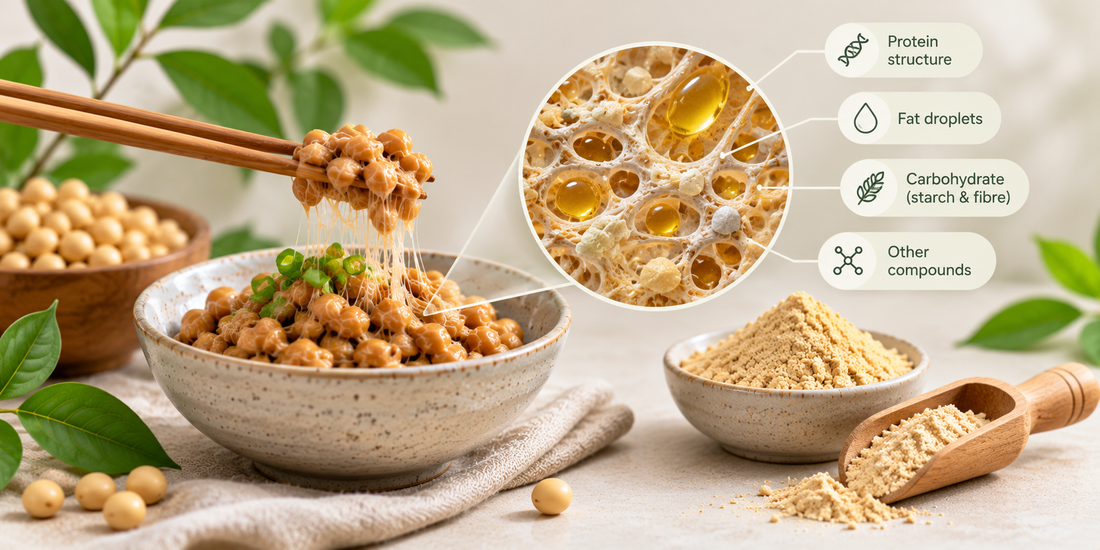
The food matrix refers to the structure and composition of a food, including the relationships between its nutrients and non-nutrient components.
These components can include:
-
Macronutrients: protein, carbohydrates and fats
-
Micronutrients: vitamins and minerals
-
Dietary fibre: different types of plant-based material that interact with digestion
-
Other compounds: naturally occurring substances such as polyphenols and other bioactive compounds
-
Physical structures: cell walls, protein networks, fat droplets and the way these elements are arranged
The matrix is not simply a list of ingredients. It also concerns how those ingredients are organised within the food.
For example, the nutrients in a whole almond are held within a structure that must be broken down during chewing and digestion. Almond flour and almond oil have different physical structures, even though they originate from the same food.
The differences do not automatically make one form better than another. They illustrate why food form and structure can matter when scientists investigate digestion, nutrient availability and the body's responses.
A 2021 review in Annual Review of Food Science and Technology describes how food structure and composition can influence the digestion of macronutrients and the availability of nutrients for absorption.
Why does food structure matter?
Digestion is not just a process of breaking food into smaller chemical components. It also involves physical changes, mixing with digestive fluids and the action of enzymes.
The structure of a food can influence how quickly these processes occur and how readily certain nutrients become available during digestion.
Three factors are particularly useful to understand.
1. How nutrients are organised
Nutrients may be enclosed within plant cell walls, incorporated into protein structures or dispersed within fat droplets.
These arrangements can affect how easily digestive enzymes reach particular components.
For example, the physical structure of a seed or nut can influence the release of its contents during chewing and digestion. Grinding changes that structure, although the overall effect depends on the food, the degree of processing and the nutrient being studied.
2. How components interact
Food components do not always behave independently.
Protein, fat, fibre, starch and other compounds can interact physically and chemically. These interactions may influence the movement of nutrients through the digestive system and the rate at which they become available for absorption.
The effect is not necessarily beneficial or harmful in every situation. It depends on the specific food, component and outcome being investigated.
3. How processing changes the structure
Cooking, grinding, blending, fermentation and other processing methods can alter the food matrix.
For example, cooking can soften some plant tissues and change the structure of proteins and starches. Grinding can break down larger structures into smaller particles. Fermentation can transform certain components through the activity of microorganisms.
Processing can make some nutrients more accessible while reducing or changing other compounds. It is therefore more accurate to assess the particular food and process than to assume all processing has the same effect.
Food matrix examples from everyday life
The following examples illustrate the concept without assuming that one food or preparation method is universally superior.
Whole fruit and fruit juice
Whole fruit contains water, sugars, fibre and other naturally occurring compounds within a physical structure.
Juicing changes that structure and may remove some of the pulp and fibre, depending on the method used. Drinking juice also differs from eating whole fruit in the way the food is consumed.
These differences can affect eating speed, satiety and the body's response to the food. However, the size and significance of any effect depend on the fruit, the juice preparation and the outcome being measured.
The example shows why comparing only the sugar content may not capture every relevant difference between whole fruit and juice.
Whole nuts and nut butter
Whole nuts contain fats, protein, fibre and other compounds within a cellular structure.
Turning nuts into butter breaks down much of that structure and changes particle size and texture. This can influence how the food is chewed and digested.
Both forms can contribute nutrients to the diet. The food matrix perspective simply reminds us that matching their nutrient profiles on paper does not guarantee identical digestion or eating behaviour.
Fermented soybeans and isolated compounds
Natto is a traditional Japanese food made by fermenting soybeans with Bacillus subtilis var. natto. The fermentation process gives it distinctive characteristics and changes aspects of the original soybean composition.
Researchers can study natto as a whole food, measure individual compounds within it, or investigate specific ingredients in isolation. These are different research questions.
A finding about an isolated compound does not automatically describe the effect of eating natto. Equally, an observation about traditional natto cannot automatically establish the effect of every natto powder or supplement.
Food matrix versus nutrient composition
Food composition and food matrix are related, but they are not interchangeable concepts.
Food composition describes what a food contains and, where measured, the quantity of each component.
Food matrix considers how those components are organised within the food and how their physical and chemical relationships may influence digestion and biological responses.
A nutrition label can tell you how much protein, fat, carbohydrate or fibre a serving contains. It does not, by itself, explain every detail of the food's structure or exactly how an individual will digest and absorb its nutrients.
This distinction matters when interpreting nutrition studies. Two foods with similar amounts of a particular nutrient may differ in their structure, texture, processing or combination of other components.
Those differences may be relevant to the research question, but they do not automatically establish that one food produces better health outcomes.
What is the difference between a whole food and an isolated compound?
An isolated compound is studied separately from much of the food structure and the other components with which it naturally occurs.
This can be valuable in research. Scientists may need to isolate a substance to understand its properties, investigate a mechanism or test a specific hypothesis.
However, findings from isolated compounds have limits when applied to whole foods or finished supplements.
Consider three different research questions:
-
A compound study: What happens when researchers test a particular compound under defined conditions?
-
A whole-food study: What outcomes are observed when people consume a specific food as part of their diet?
-
A supplement study: What happens when people take a particular formulation at a defined dose?
These studies may complement one another, but they are not interchangeable. The dose, formulation, food structure, study population and measured outcomes can all differ.
A laboratory result may help explain a possible mechanism without demonstrating a benefit in humans. An observational study of food intake may identify an association without proving that the food caused the outcome. A study of one supplement formulation does not necessarily establish the effects of other formulations.
The key is to match the conclusion to what the researchers actually tested.
Does the food matrix prove that whole foods are always better?
No. The food matrix is a scientific framework for understanding food structure and interactions, not a rule that every whole food is superior to every processed food or supplement.
Processing can have practical and nutritional advantages. Cooking can improve the digestibility of some foods, while grinding and other methods can change how nutrients are released. Processing may also improve safety, convenience and shelf life.
Likewise, supplements can be useful in specific circumstances, depending on a person's nutritional needs and professional advice.
The relevant question is not simply whether a food is whole, processed or supplied as a supplement. It is what the product contains, how it is prepared, what evidence exists for the intended use and whether that evidence applies to the specific product or population.
A 2025 review, Overview: The Food Matrix and Its Role in the Diet, discusses the complexity of food matrices and the challenges of translating food-matrix research into dietary guidance. The authors highlight the importance of considering whole foods and dietary patterns alongside individual nutrients.
How to read food matrix research critically
When you encounter a claim about a food, ingredient or supplement, use these questions to assess the evidence:
-
What was studied? Was it a whole food, an isolated compound, an extract or a finished supplement?
-
Who or what was studied? Was the research conducted in a laboratory, in animals or in humans?
-
What was measured? Did researchers measure chemical composition, nutrient absorption, a biological marker, symptoms or a meaningful health outcome?
-
What was the comparison? Was the food compared with a placebo, another food, an isolated ingredient or no intervention?
-
Does the conclusion match the evidence? A change in nutrient availability or a laboratory measurement does not, by itself, prove a clinical benefit.
-
Can the findings be applied to the product being discussed? Consider differences in preparation, formulation, dose and study conditions.
These questions are especially useful when a marketing claim refers to research on a food but promotes a supplement—or when a study of one ingredient is used to make claims about a complex food.
What does this mean for natto and natto supplements?
Natto provides a useful example of why context matters.
Traditional natto is a fermented soybean food with a distinctive composition and physical structure. Natto powder and capsule products may differ from the traditional food in preparation, moisture content, processing and serving size.
Research on natto as a food can help explain its nutritional and scientific context. Research on a specific natto powder formulation may provide information about that formulation under the conditions studied.
Neither type of evidence should automatically be extended to every natto product or used to promise a particular health outcome.
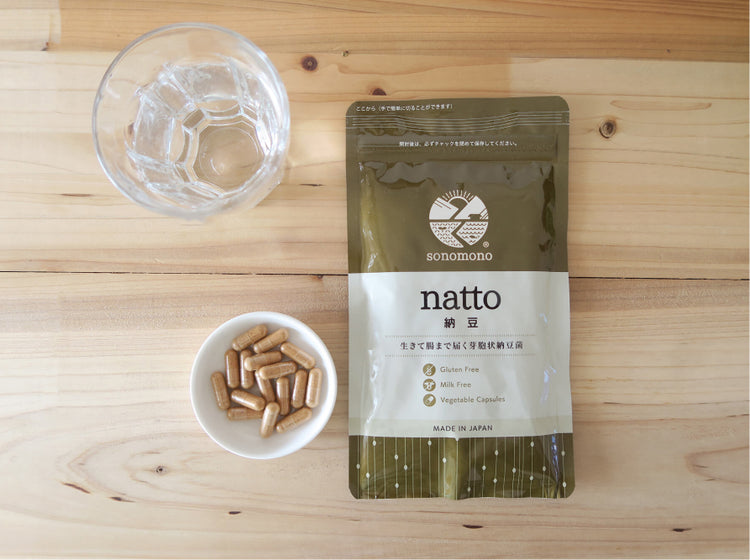
If you are exploring this topic, start with our introduction to natto. You can also review the ingredients and formulation details of sonomono® Natto Powder Capsules.
These pages provide product and ingredient context, not proof that a particular food-matrix mechanism produces a clinical benefit. Product-specific claims should be supported by evidence that directly addresses the formulation and the outcome being claimed.
The bottom line
The food matrix helps explain why food is more than the sum of its nutrient values on a label. Its structure, composition and the interactions between its components can influence digestion and the availability of nutrients.
It also provides an important lesson for interpreting nutrition research: a result involving an isolated compound may not translate directly to a whole food, and findings about a whole food may not apply to a supplement made from it.
Understanding the food matrix means looking beyond individual ingredients while remaining careful about what the evidence actually demonstrates.
Educational disclaimer: This article is for general informational purposes only and is not intended to diagnose, treat, cure or prevent any disease, or replace personalised medical or nutritional advice.